Yes. A weak or failed capacitor is one of the most common reasons an AC trips the circuit breaker. The capacitor gives the compressor and fan motor the boost they need to start. Without it, the compressor stalls and pulls several times its normal current until the breaker trips, and a capacitor that shorts internally can trip it instantly. The six warning signs are a humming outdoor unit that won’t start, a fan that won’t spin, a breaker that trips at startup, warm air from the vents, an AC that shuts off soon after starting, and a capacitor that’s swollen or tests low. Leave the breaker off and call a licensed technician.
Key takeaways
- A humming outdoor unit that won’t start is the classic sign. The motor is getting power but can’t turn without the capacitor’s boost.
- Every failed start is hard on the compressor. Leave the breaker off after one trip instead of letting the system keep trying.
- Capacitors can fail without looking damaged. A bulging top is a giveaway, but many bad capacitors look normal and only show up on a meter.
- Texas heat is their biggest enemy. Capacitor failures cluster on the hottest afternoons of the year.
- This isn’t a DIY repair. A capacitor can hold a dangerous charge after the power is off, and the replacement has to match the original’s rating exactly.
A capacitor is a small cylinder in the outdoor unit that stores and releases energy to start the compressor and the condenser fan motor, then helps keep them running smoothly. Most home systems use a single dual run capacitor that serves both motors, so when it weakens, both can struggle at once. For a deeper look at how the part works, see what a capacitor does in your AC. Capacitors are one of nine common causes covered in our main guide, Why Does My AC Trip the Circuit Breaker? 9 Common Causes and Fixes. The warning signs below are ordered by how often they show up.
1. The Outdoor Unit Hums but Won’t Start
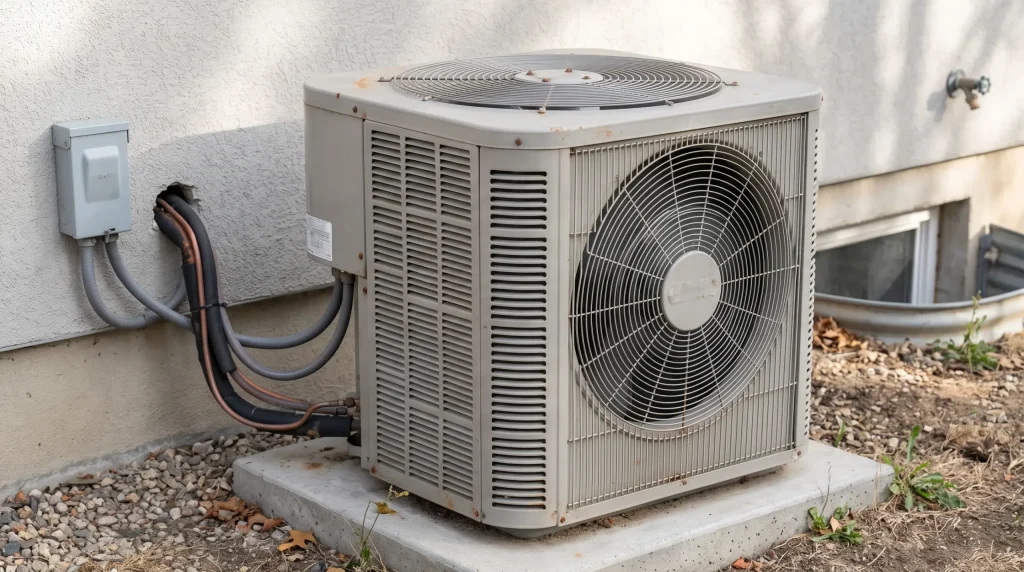
Why a bad capacitor makes your AC hum without starting
A steady hum from the outdoor unit with no fan movement is the most recognizable sign of a bad capacitor. The compressor and fan motors are receiving power, but without the capacitor’s starting boost they can’t begin turning. A stalled motor draws very high current, so within seconds either the compressor’s internal overload shuts it off or the breaker trips.
Symptom: When the thermostat calls for cooling, the outdoor unit buzzes or hums for several seconds. The fan on top doesn’t turn, and then the unit goes quiet or the breaker trips.
Most likely cause: A failed start capacitor, or a dual run capacitor that has lost too much capacity to start the motors. Humming is one of the noises that mean HVAC system trouble, and it should never be ignored.
Fix steps:
- Set the thermostat to off so the system stops trying to start.
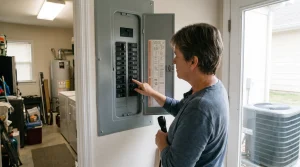
- Turn off the breaker for the outdoor unit.
- Note how long the hum lasted and whether the fan moved at all. This helps the technician confirm the problem quickly.
Call a pro if: You hear this at all. Every stalled start heats the compressor windings, so letting it keep trying can turn a small repair into a big one. If the capacitor tests good, the compressor itself may be struggling to start, which is covered in Why Does My AC Trip the Breaker When the Compressor Kicks On? 5 Causes.
2. The Outdoor Fan Won’t Spin, or Spins Slowly
How to tell if a bad capacitor is stopping your AC fan
On most systems, the condenser fan motor draws from the same dual run capacitor as the compressor. When the fan side of the capacitor weakens, the fan may not start at all, may start only after a delay, or may turn noticeably slower than normal. Without that airflow, heat builds up in the outdoor unit and the compressor overheats, which can trip the breaker or shut the compressor down.
Symptom: You can hear or feel the compressor running, but the fan blades on top are still or turning slowly. The air coming off the top of the unit is weak.
Most likely cause: A weak fan side on the dual run capacitor. A worn fan motor causes similar symptoms, which is why testing matters.
Fix steps:
- Turn off power at the thermostat, the outdoor disconnect, and the breaker.
- Look through the top grille for sticks, leaves, or anything blocking the blades.
- Don’t push the fan with a stick to get it started. It may spin for a while, but it hides the real problem and puts your hands near high voltage and moving blades.
Call a pro if: The fan still won’t spin with nothing blocking it. Replacing a capacitor is usually a quick, affordable HVAC repair. If the motor turns out to be the problem, our guide to an AC fan not working covers the other causes.
3. The Breaker Trips the Moment the AC Tries to Start
Why a failing capacitor trips the AC breaker at startup
A weak capacitor stretches out the compressor’s start. Instead of a brief spike of current, the motor pulls high current for several seconds, which is long enough to trip the breaker. A capacitor that has shorted internally is more direct: it creates a short circuit and can trip the breaker the instant the unit switches on.
Symptom: The thermostat calls for cooling, you may hear a click and a hum, the lights may dim, and the breaker trips within a few seconds.
Most likely cause: A weak or shorted capacitor. A hard-starting compressor, a pitted contactor, or a wiring fault can cause the same pattern.
Fix steps:
- Set the thermostat to off.
- Reset the breaker once by pushing it fully to off, then back to on.
- Wait at least five minutes, then set the thermostat back to cool.
- If it trips again, leave the breaker off. The Electrical Safety Foundation International advises getting a professional involved when a breaker keeps tripping, rather than resetting it over and over.
Call a pro if: The breaker trips a second time. If it trips even when the outdoor unit sounds and runs normally, the breaker itself may be failing, and Is My AC Breaker Bad or Is It the AC? 5 Ways to Tell walks through how to tell the difference.
4. The Vents Blow Warm Air While the Indoor Fan Runs
Why a bad capacitor makes your AC blow warm air
The indoor blower and the outdoor compressor are powered separately. When the compressor’s capacitor fails, the indoor blower keeps moving air through the house, but nothing is removing heat from it, so the vents blow room-temperature or warm air. This is often how homeowners first notice the problem, because it shows up inside the house.
Symptom: Air is moving from the vents but isn’t cold. When you check outside, the outdoor unit is silent, humming, or running with the fan stopped.
Most likely cause: A failed compressor side on the capacitor. Capacitor failures tend to cluster in heat waves, because high outdoor temperatures break them down faster. When the National Weather Service forecasts a stretch of triple-digit days for North Texas, that’s when an already weak capacitor is most likely to give out.
Fix steps:
- Check that the thermostat is set to cool and a few degrees below the room temperature.
- Check the air filter and replace it if it’s clogged.
- Go outside and listen. If the indoor fan is running but the outdoor unit is quiet or humming, set the thermostat to off.
Call a pro if: The outdoor unit isn’t running normally while the indoor fan is. For other causes of this symptom, see our guide to an air conditioner blowing warm air. If your AC seems to cool a little less every summer rather than failing all at once, an energy assessment can verify the system’s performance, settings, and airflow to find where cooling is being lost.
5. The AC Shuts Off Soon After Starting
Why a weak run capacitor makes your AC short cycle
Sometimes a weak capacitor still has enough strength to start the compressor but not enough to keep it running efficiently. The motor runs hot, and its internal thermal overload shuts it off to protect it. A few minutes later it cools down, restarts, and the cycle repeats while the house slowly warms up.
Symptom: The outdoor unit runs for a few minutes, clicks off, and restarts later. The thermostat never reaches its setting on hot days.
Most likely cause: A run capacitor that’s below its rated capacity. Short cycling has other causes too, including thermostat problems, refrigerant issues, and an oversized system, which our guide to AC short cycling covers.
Fix steps:
- Replace the air filter if it’s dirty.
- Check that the thermostat isn’t in direct sun or near a heat source.
- Time a few cycles. If the unit runs only a few minutes before shutting off and then sits idle, mention it to the technician.
Call a pro if: The cycling continues. Repeated overheating wears down the compressor’s windings, and if the compressor on an older system has already been damaged, HVAC replacement may be the better investment. When an aging compressor starts hard even with a good capacitor, a technician may recommend a hard-start kit. For the technical side, see HVAC trade coverage from ACHR News, which regularly covers hard-start kits and compressor troubleshooting.
6. The Capacitor Looks Swollen or Tests Low
How technicians confirm a bad AC capacitor
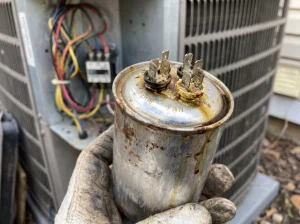
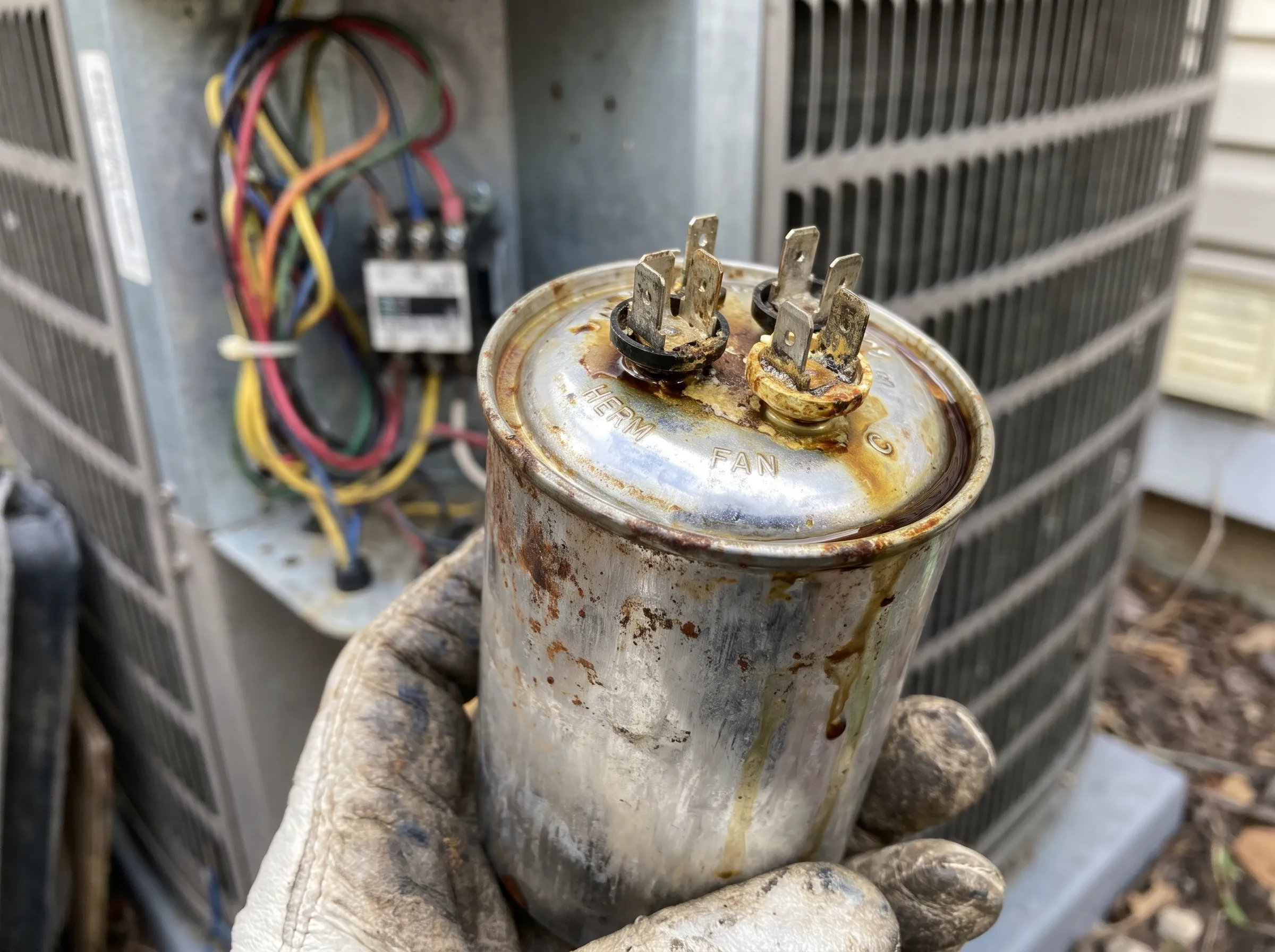
A healthy capacitor has a flat top. A failing one may have a domed or bulging top, oily residue leaking from the case, or rust and burn marks at the terminals. But many capacitors fail with no visible damage at all, so the real test is a meter reading. Every capacitor is labeled with its rating in microfarads and an allowed tolerance, and a reading below that range means it needs to be replaced.
Symptom: A technician finds a bulging or leaking capacitor, or one that measures below its rated capacity. Sometimes a capacitor fails suddenly right after a thunderstorm or power outage.
Most likely cause: Age and heat wear capacitors down over time. Power surges can damage them in an instant, which is one reason power surges and the HVAC damage they cause are worth understanding before storm season.
Fix steps:
- Don’t remove the outdoor unit’s access panel to look. The capacitor sits next to high-voltage connections and can hold a dangerous charge even after the power is off.
- If a tune-up report says your capacitor tested weak, schedule the replacement before the next heat wave.
Call a pro if: You suspect the capacitor at all. A technician discharges it safely, measures it with professional capacitance meters, and confirms the replacement matches the original’s microfarad and voltage rating. If capacitors keep failing on the same system, the cause may trace back to the original HVAC installation, such as a system sized too large that cycles on and off constantly.
Capacitor Warning Signs: What You Can Check vs. When to Call a Pro
What to do when you suspect a bad AC capacitor
Warning sign | What it usually means | Safe to do yourself | Call a pro when |
Outdoor unit hums but won’t start | The capacitor can’t start the motors | Turn the thermostat and breaker off | Right away, since failed starts heat the compressor |
Fan won’t spin or spins slowly | Weak fan side of the capacitor, or a worn fan motor | Clear debris from the blades with the power off | The fan still won’t turn |
Breaker trips at startup | Weak or shorted capacitor | Reset once and wait five minutes | It trips a second time |
Warm air from the vents | The compressor isn’t running | Check the thermostat and filter | The outdoor unit is quiet or humming |
AC shuts off soon after starting | A weak run capacitor is overheating the motor | Replace a dirty filter and time the cycles | The cycling continues |
Capacitor swollen or tests low | The capacitor has failed or is failing | Nothing; don’t open the unit | Always, since it holds a charge |
Replace a Weak Capacitor Before It Takes Out Your Compressor
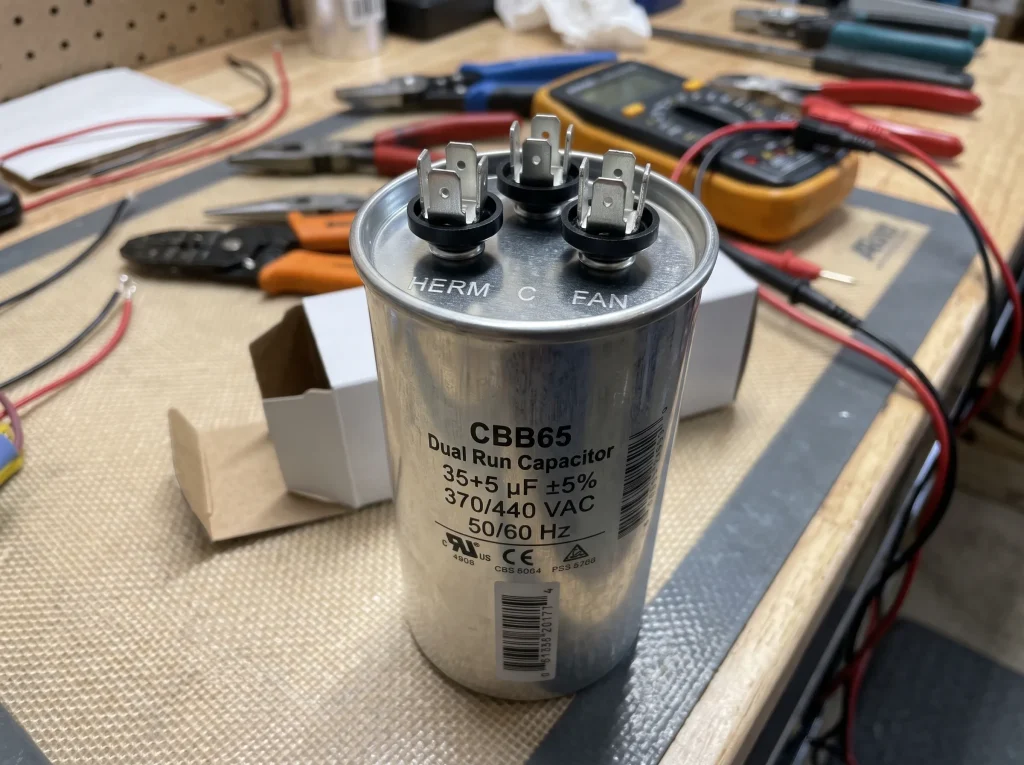
How to make your AC capacitor last longer
A capacitor is one of the least expensive parts in your AC, but the damage a failing one causes isn’t. Every hard start and overheated cycle wears on the compressor, the most expensive part of the system. The best protection is a yearly tune-up that measures the capacitor before summer. Here’s what a professional AC tune-up checks. Keeping the outdoor coil clean, adding surge protection, and reducing how hard your system has to work all help too. If your AC runs nearly nonstop on summer afternoons, a structure energy review can find the insulation and airflow problems behind it.
If you’ve noticed any of these warning signs, AC Repair DFW can help. Our licensed technicians serve Bedford and the surrounding DFW area, and they’ll test your capacitor and replace it if it’s failing. Schedule same-day AC repair or get a free quote.