Your AC trips the breaker when the compressor kicks on because startup pulls far more current than normal running, and something is making that surge too big or too long. The five most common causes are a weak capacitor, a pitted contactor, a hard-starting compressor, a grounded or shorted compressor winding, and low voltage from loose connections. A healthy start pulls a brief spike the breaker is built to ride through. When the spike lasts several seconds, or a winding is shorted to ground, the breaker trips. Reset it once and wait five minutes. If it trips again at startup, leave it off and call a licensed technician.
Key takeaways
- A startup spike is normal. A startup trip is not. Every compressor pulls a big surge for a split second when it starts, and breakers are designed to tolerate it. A trip means the surge is too large or lasts too long.
- Check the capacitor first. It’s the most common cause of startup trips and usually the least expensive fix.
- An instant trip with no hum points to a grounded compressor. It can’t be repaired, and resetting the breaker again and again is a safety risk.
- Stop flipping the thermostat off and on. Restarting before the system’s pressures even out forces the compressor to start against high pressure.
- A hard-start kit only helps a healthy but aging compressor. It won’t fix a bad capacitor, a failing contactor, or a grounded winding.
When the breaker trips tells you a lot. If it trips the instant you reset it, before the thermostat calls for cooling, the problem is in the wiring or the breaker, not the compressor. If it holds until the outdoor unit clicks on and then trips within a few seconds, you’re dealing with one of the five causes below, which are ordered by how often they show up. This guide focuses on that startup trip. For every reason an AC can trip the breaker, see Why Does My AC Trip the Circuit Breaker? 9 Common Causes and Fixes. If your compressor runs but won’t cool, or makes noise without tripping anything, see our guide to an AC compressor not working.
1. A Weak or Failed Capacitor
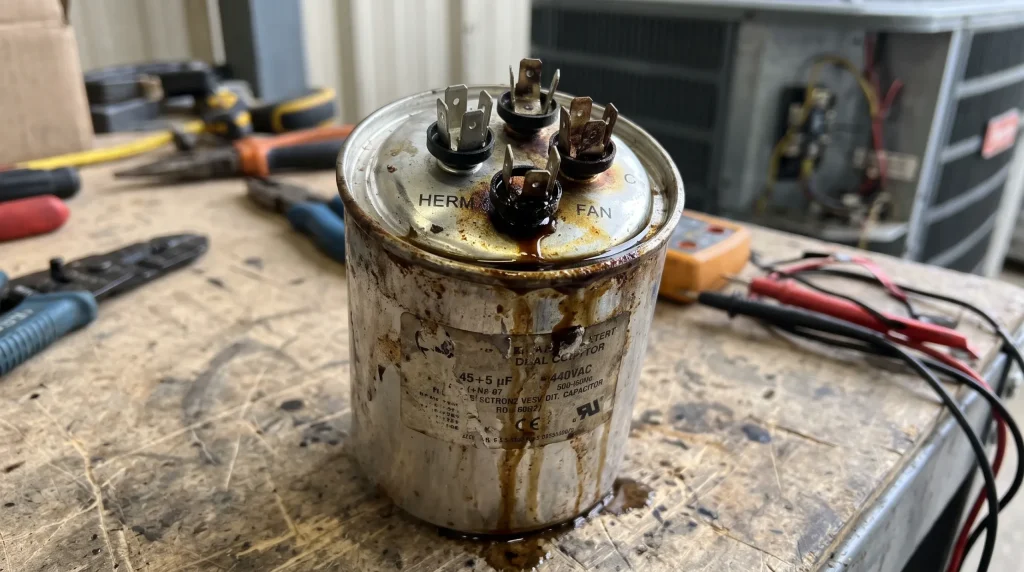
Why a bad capacitor makes your AC trip the breaker when the compressor starts
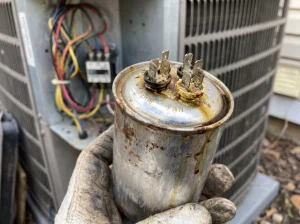
The capacitor gives the compressor motor the extra push it needs to start turning. When the capacitor is weak, the compressor takes too long to reach speed and stays at its starting current, several times its normal running current, long enough to trip the breaker. When the capacitor is shorted, it can trip the breaker almost instantly.
Symptom: When the thermostat calls for cooling, the outdoor unit hums or buzzes for a few seconds. The fan on top may not spin, and then the breaker trips or the unit goes quiet.
Most likely cause: A dual run capacitor that has lost capacity from age and heat, or a failed start capacitor on systems that have one.
Fix steps:
- Set the thermostat to off.
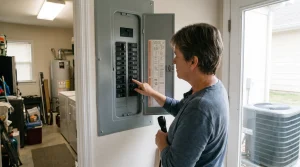
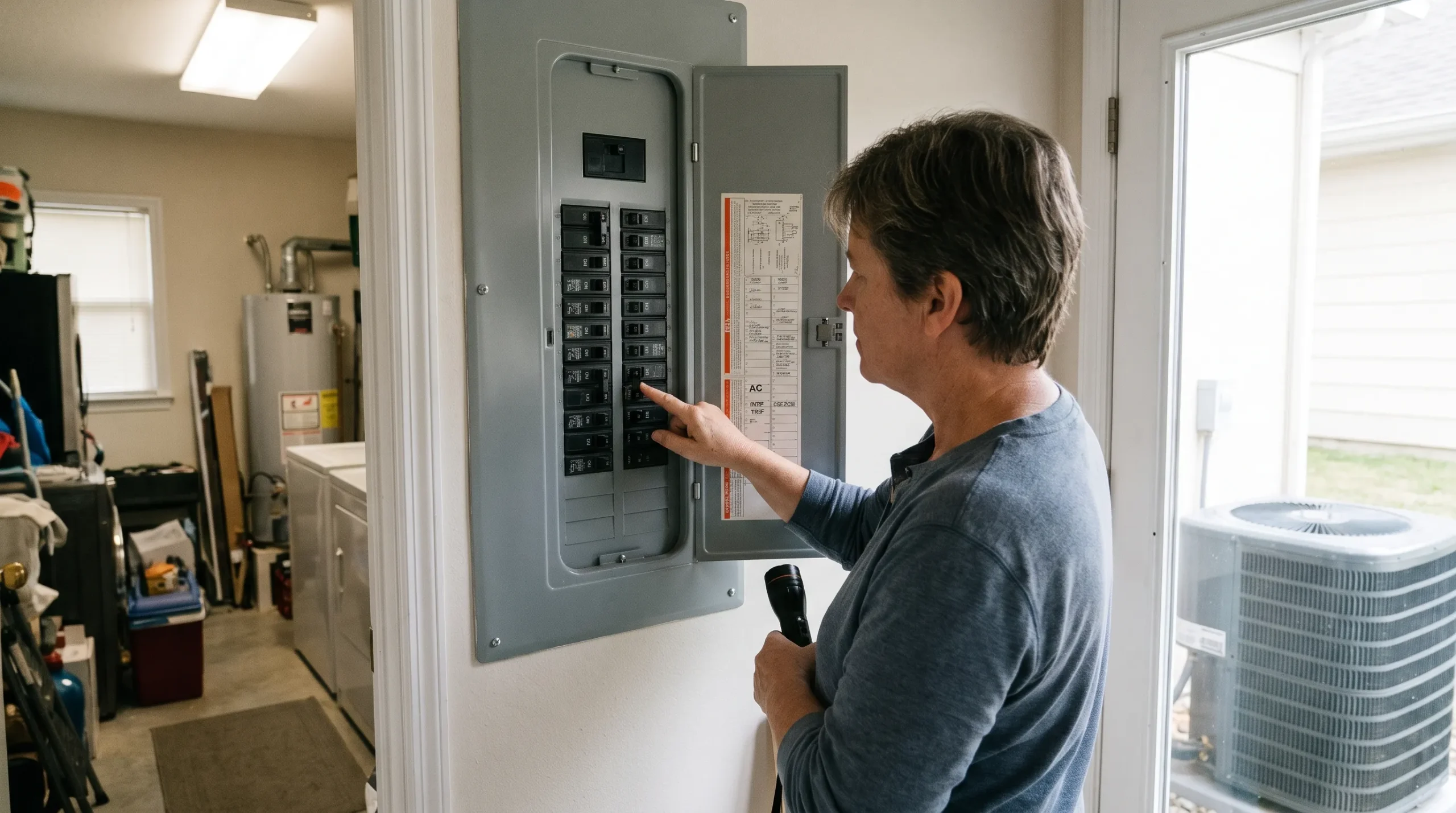
- Turn off the breaker for the outdoor unit.
- Don’t keep retrying. Every stalled start heats the compressor windings.
Call a pro if: You hear the hum-then-trip pattern at all. Capacitor replacement is usually a quick, affordable HVAC repair, and fixing it early protects the compressor. For every symptom of a failing capacitor, read Can a Bad Capacitor Make My AC Trip the Breaker? 6 Warning Signs.
2. A Pitted or Failing Contactor
How a bad contactor makes your AC trip the breaker at startup
The contactor is the switch in the outdoor unit that closes to send power to the compressor when the thermostat calls for cooling. Each time it closes, a small arc forms across its contacts, and over the years they burn and pit. Pitted contacts don’t close cleanly. They chatter, arc, and deliver reduced voltage, so the compressor tries to start on weak power, draws even more current, and trips the breaker. Ants and other insects that crawl into the contactor can keep it from closing properly too.
Symptom: Chattering, buzzing, or rapid clicking from the outdoor unit when it tries to start, followed by a trip. In some cases the contacts weld shut, and the outdoor unit keeps running even after you turn the thermostat off.
Most likely cause: Worn, pitted, or welded contacts, or insects or debris inside the contactor.
Fix steps:
- If the outdoor unit won’t shut off, turn it off at the breaker.
- Note the sounds you hear at startup. Chattering and clicking point to the contactor more than the compressor.
- If you see ants swarming around the base of the unit, mention it to the technician.
Call a pro if: You hear chattering or buzzing at startup, or the unit won’t shut off. Replacing a contactor is typically a quick, low-cost repair. If clicking is your main clue, see why your HVAC system is making a clicking noise, and for buzzing and other sounds, see what different HVAC noises mean.
3. A Hard-Starting Compressor
Why a hard-starting compressor trips the AC breaker
As a compressor ages, internal wear makes it harder to start. Timing matters too. When the system shuts off, pressure stays high on one side and low on the other for a few minutes before it evens out. If the compressor tries to restart before that happens, whether from a short off cycle, a power flicker, or someone flipping the thermostat, it has to start against that pressure difference. A compressor that can’t overcome it stalls at its starting current until the breaker or its internal overload trips. Heat makes it worse, because hot afternoons raise the pressure the compressor starts against. In the worst case, a compressor that has seized mechanically never turns at all.
Symptom: Trips mostly on hot afternoons, after short off cycles, or right after the power flickers. The lights dim noticeably each time the outdoor unit tries to start, and you may hear a hum, a click, and then silence.
Most likely cause: An aging compressor, restarts before pressures equalize, or high operating pressure from a dirty outdoor coil or an overcharged system.
Fix steps:
- After a trip, set the thermostat to off and reset the breaker once.
- Wait at least five minutes before switching back to cool.
- Don’t flip the thermostat off and on to “reset” the AC. That forces exactly the kind of hard start that trips the breaker.
- Keep the outdoor coil clean so the compressor isn’t starting against extra pressure.
Call a pro if: It trips again at startup. A technician will confirm the capacitor and contactor are good, then measure the compressor’s starting current. If the compressor is healthy but aging, a hard-start kit (an added start capacitor and relay) can give it the extra starting torque it needs. For the technical side, technical reporting from ACHR News regularly covers hard-start kits and compressor troubleshooting. Frequent restarts are hard on compressors, so if your system turns on and off every few minutes, our guide to AC short cycling explains the other causes. Compressors in homes where the AC runs nearly nonstop also wear out sooner, and a structure energy review can find the insulation and airflow problems that keep yours running.
4. A Grounded or Shorted Compressor Winding
How to tell if a grounded compressor is tripping your AC breaker
The motor inside your compressor is sealed in a steel shell, and its copper windings are coated with insulation. Years of heat, repeated hard starts, power surges, or contamination can break that insulation down until a winding touches the metal shell (a grounded compressor) or another winding (a shorted compressor). A grounded compressor sends current straight to ground the moment it’s energized, so the breaker trips instantly, every single time.
Symptom: The breaker trips the instant the outdoor unit clicks on, with no hum and no attempt to start. It happens every time, not just on hot days. You may notice a burnt smell near the unit.
Most likely cause: Winding insulation failure, often after years of overheating, repeated hard starts, or a power surge.
Fix steps:
- Leave the breaker off. Each reset sends fault current through the damaged winding and the wiring feeding it.
- Find the manufacture date on the outdoor unit’s nameplate. The age of the system will shape the repair-or-replace decision.
Call a pro if: You see this pattern at all. A technician confirms it with winding resistance and insulation resistance tests, using professional electrical testing tools. A grounded compressor can’t be repaired, and a hard-start kit won’t help. The compressor has to be replaced, and a burned-out compressor can also contaminate the refrigerant system, which adds to the repair. On an older system, HVAC replacement is often the better investment. Our guide on whether to repair or replace your AC unit walks through that decision.
5. Low Voltage or Loose Connections at Startup
Why low voltage makes your AC trip the breaker when the compressor kicks on
A compressor needs full voltage to start. Loose or corroded connections at the breaker, disconnect, or contactor, damaged wiring, or wiring that’s too small for the unit can let the voltage sag during the startup surge. The motor then takes longer to start and pulls even more current, which heats those weak connections further. A loose connection at the breaker can also heat the breaker itself and make it trip more easily.
Symptom: The lights dim sharply when the AC starts, trips come and go with no clear pattern, and you may notice a burning smell near the disconnect or the panel. The breaker may feel warm.
Most likely cause: Loose or corroded terminals, damaged wiring, or a circuit that was never properly matched to the unit.
Fix steps:
- Turn off the power at the breaker.
- Look at the disconnect box and the conduit running to the unit for melted or discolored insulation, without opening any panel.
- Reset the breaker once. Following electrical safety guidance from ESFI, get a professional involved if it keeps tripping instead of resetting it over and over.
Call a pro if: You smell burning or see any damage, because loose connections are a fire hazard. If the breaker trips even when the compressor starts smoothly, the breaker itself may be failing, and Is My AC Breaker Bad or Is It the AC? 5 Ways to Tell walks through how to tell. If the wiring or breaker was never sized for your unit, the problem likely traces back to the original HVAC installation or a system swap where the circuit wasn’t rechecked.
Compressor Startup Trips: What You Can Check vs. When to Call a Pro
What to do when your AC trips the breaker as the compressor starts
|
Cause |
What you’ll notice |
Safe to do yourself |
Call a pro when |
|
Weak or failed capacitor |
A hum for a few seconds, the fan may not spin, then a trip |
Turn the thermostat and breaker off |
Right away, since failed starts heat the compressor |
|
Pitted or failing contactor |
Chattering or buzzing at startup, or a unit that won’t shut off |
Turn it off at the breaker if it won’t stop |
Any chattering, buzzing, or welded contacts |
|
Hard-starting compressor |
Trips on hot afternoons or after short off cycles, lights dim |
Reset once, wait five minutes, stop flipping the thermostat |
It trips again at startup |
|
Grounded or shorted winding |
An instant trip every time, with no hum |
Leave the breaker off |
Right away |
|
Low voltage or loose connections |
Lights dim sharply, trips come and go, burning smell |
Look for damage without touching or opening panels |
Any burning smell or visible damage |
Protect Your Compressor by Fixing Startup Trips Early
How to keep your compressor from tripping the breaker
The compressor is the most expensive part of your AC, and most startup trips begin with smaller parts: a capacitor, a contactor, or a connection. Catching those early is what keeps the compressor alive. A yearly tune-up that tests the capacitor, inspects the contactor, tightens connections, and measures starting current is the best protection. Here’s what a professional AC tune-up checks. Aim to have it done before the first National Weather Service heat advisories of the year, since a marginal compressor is most likely to fail on the hottest days. For a deeper look at how your system is performing, an energy assessment verifies its performance, settings, and airflow.
If your AC trips the breaker every time the compressor kicks on, AC Repair DFW can help. Our licensed technicians serve Bedford and the surrounding DFW area, and they’ll test the capacitor, contactor, and compressor to find the real cause before recommending a fix. Request same-day AC repair or a free quote.