If your AC shows trouble before the breaker trips, such as humming, chattering, a fan that won’t spin, or warm air from the vents, the AC is usually the cause. If the AC runs normally right up until the trip, or the breaker feels warm, buzzes, won’t reset firmly, or doesn’t match the size on the unit’s nameplate, the breaker is the likely problem. A breaker that trips instantly with the thermostat off points to the wiring or the breaker itself. The only way to know for sure is an amp-draw test: if the AC draws normal current and the breaker still trips, the breaker is bad.
Key takeaways
- Timing is your first clue. A trip the moment the compressor starts points to the AC. An instant trip with the thermostat off points to the wiring or the breaker.
- A healthy AC rarely trips a healthy breaker. When the AC is the cause, it usually gives warning signs first.
- Breakers do wear out. Repeated trips, heat, and loose connections can make a breaker trip below its rating.
- Never install a bigger breaker. The right size is printed on the outdoor unit’s nameplate, and going larger creates a fire risk.
- Measurement settles it. A technician compares the AC’s actual current draw with its nameplate rating to tell you which one is at fault.
A circuit breaker is a safety switch. It trips when too much current flows through the circuit, when there’s a short, or when it has worn out and trips too easily. Your AC’s outdoor unit usually has its own double-pole breaker (two handles joined together) in the main panel, plus a disconnect box near the unit. Before you start, note which breaker tripped and reset it only once. Our guide on how to reset your HVAC system covers the basics. If you want the full list of reasons an AC trips the breaker, start with Why Does My AC Trip the Circuit Breaker? 9 Common Causes and Fixes. The five checks below narrow down whether the breaker or the AC is to blame, and they work best in order.
1. Notice When the Breaker Trips
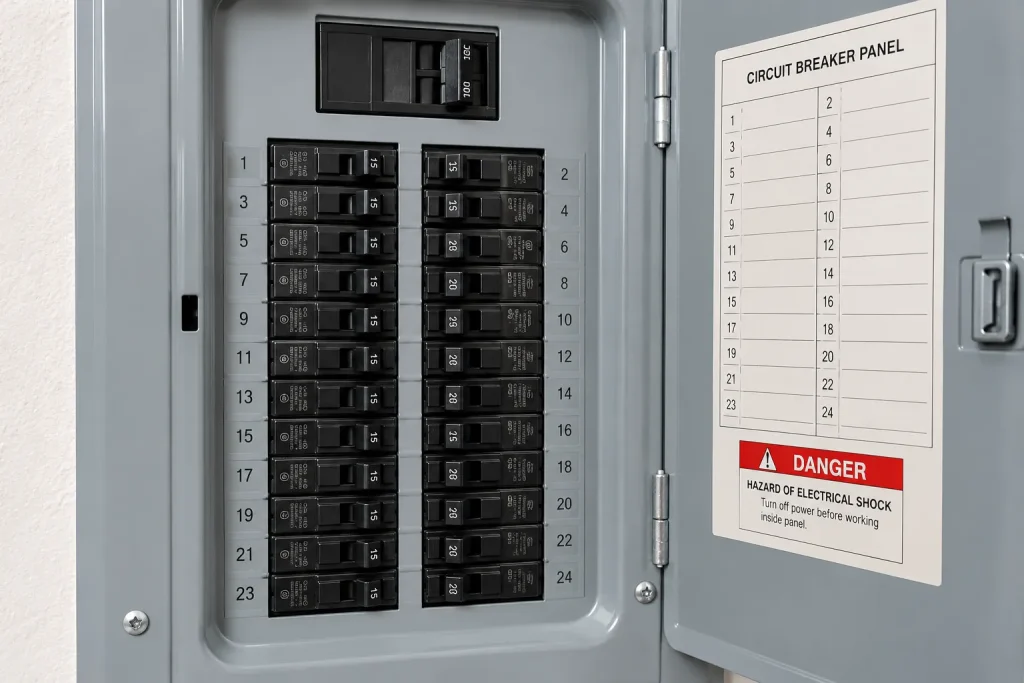
How the timing tells you if it’s the breaker or the AC
When the breaker trips is the fastest way to point toward the breaker or the AC. With the thermostat off, the outdoor unit draws almost no current, so a breaker that trips the instant you reset it points to a short in the wiring or a failed breaker. A trip the moment the compressor kicks on points to the AC. A trip after the system has run for a while can be either one, and random trips with no pattern often mean a loose connection or a worn breaker.
Symptom: The breaker trips at a consistent moment: instantly on reset, a few seconds after the outdoor unit starts, after 15 to 30 minutes of running, or at random.
Most likely cause:
- Instantly on reset, thermostat off: a short in the wiring or disconnect, or a failed breaker.
- When the compressor starts: the AC, usually the capacitor, contactor, or compressor. Why Does My AC Trip the Breaker When the Compressor Kicks On? 5 Causes covers this pattern in detail.
- After running a while on hot afternoons: either an overworked AC, often from dirty condenser coils, or a weak breaker heating up.
- At random: a loose connection or a worn breaker.
Fix steps:
- Set the thermostat to off and reset the breaker once.
- Watch what happens. Note whether it trips immediately, when the unit starts, or later.
- Write down the time and roughly how hot it was outside. Patterns help the technician.
Call a pro if: The breaker trips a second time, whatever the timing. If your system runs almost nonstop on summer afternoons before it trips, a structure energy review can find the insulation and airflow problems that make it work so hard.
2. Watch and Listen to the AC Before It Trips
Signs the AC, not the breaker, is causing the trip
A healthy breaker trips because something on the circuit is drawing too much current, and when that something is your AC, it usually gives warning. If the outdoor unit hums, chatters, grinds, or smells hot before the trip, or the house has been warming up for days, the AC is the likely cause. If the AC starts smoothly, cools normally, and sounds fine right up until the breaker trips, the breaker moves higher on the suspect list.
Symptom: Before the trip, you notice humming or buzzing from the outdoor unit, a fan on top that won’t spin, chattering or clicking, the lights dimming sharply at startup, or warm air from the vents.
Most likely cause: A problem in the AC, most often a weak capacitor, a pitted contactor, a failing fan motor, or a compressor that’s struggling to start.
Fix steps:
- Stand near the outdoor unit when the thermostat calls for cooling and listen to how it starts.
- Check whether the fan on top begins spinning within a few seconds.
- Feel the air at a vent inside. Warm air while the indoor fan runs means the outdoor unit isn’t doing its job.
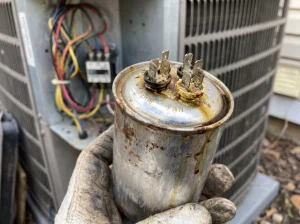
Call a pro if: You notice any of these signs. The fix is an HVAC repair, not a new breaker. Humming and a stalled fan are classic capacitor symptoms, covered in Can a Bad Capacitor Make My AC Trip the Breaker? 6 Warning Signs. If the fan is the main issue, see our guide to an AC fan not working.
3. Check the Breaker for Heat, Buzzing, or Damage
Signs of a bad AC breaker
Breakers are mechanical devices, and they wear out. After many trips, or years of heat, the internal trip mechanism can weaken until the breaker trips below its rated current. A loose connection where the breaker clips onto the panel, or where the wire attaches to it, creates heat that makes the breaker trip even more easily. Heat matters here because breakers respond to temperature. A panel in a hot garage, or an outdoor panel in the afternoon sun, runs warmer, so a weak breaker is most likely to trip on days when the National Weather Service forecast calls for triple digits.
Symptom: The breaker handle or panel cover feels noticeably warmer than the breakers around it. You hear buzzing or crackling at the panel, notice a burning smell, or see discoloration or scorch marks. The handle may feel loose, or it may not stay in the on position.
Most likely cause: A worn breaker, a loose connection at the breaker, or an aging panel. Some older panels, including Federal Pacific Electric (FPE) Stab-Lok and Zinsco panels, have well-documented reliability concerns and are routinely flagged by home inspectors.
Fix steps:
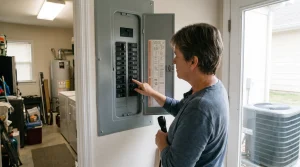
- Without removing the panel cover, carefully touch the face of the AC breaker handle and compare it with the breakers next to it.
- Listen for buzzing or crackling near the panel.
- Check the label inside the panel door for the manufacturer’s name.
- If you smell burning or see scorch marks, don’t touch anything. Keep the AC off and call for help right away.
Call a pro if: The breaker is warm, buzzing, discolored, or won’t reset firmly. A technician can check the breaker and its connections for heat and voltage drop using professional electrical test equipment. A burning smell from the panel is one of the HVAC emergency signs you shouldn’t wait on.
4. Compare the Breaker to the AC’s Nameplate
How to tell if your AC breaker is the wrong size
Every outdoor unit has a nameplate listing its electrical requirements. Two numbers matter: the minimum circuit ampacity, and the maximum breaker or fuse size (sometimes listed as maximum overcurrent protection). The breaker protecting the AC should be at least the minimum and no larger than the maximum, and the wiring has to be sized to match. A breaker that’s too small trips during normal operation. A breaker that’s too large won’t trip soon enough to protect the wiring. Mismatches are most common after a new system goes onto an old circuit without anyone rechecking the breaker and wire.
Symptom: The breaker’s amp rating (the number on its handle) is lower than the minimum circuit ampacity or higher than the maximum breaker size on the nameplate. The trips may have started soon after a system replacement or panel work.
Most likely cause: A breaker or circuit that wasn’t matched to the unit when it was installed or replaced.
Fix steps:
- Find the nameplate on the side or back of the outdoor unit.
- Write down the minimum circuit ampacity and the maximum breaker or fuse size.
- Read the number on the AC’s breaker handle in the panel. Reading both numbers is safe; opening the panel is not.
Call a pro if: The numbers don’t match. Never swap in a larger breaker to stop nuisance trips, because the wire may not be rated for it. ESFI’s home electrical safety resources recommend having a qualified, licensed electrician handle electrical work in your home, and that includes replacing a breaker. A proper HVAC installation should include checking the circuit against the new unit’s nameplate before the system is turned on.
5. Have a Technician Measure the AC’s Amp Draw
The test that proves whether it’s the breaker or the AC
The first four checks point you in the right direction. This one gives the answer. A technician clamps a meter around the wires feeding the compressor and fan motor and measures the current the AC draws while starting and while running. Those readings are compared with the rated load amps on the nameplate. The technician also checks the voltage at the unit and may test the compressor windings for a ground fault. If the AC draws normal current and the breaker still trips, the breaker or its connection is bad. If the AC draws more than it should, the problem is in the unit.
Symptom: The breaker has tripped more than once, and the first four checks didn’t give a clear answer.
Most likely cause: Normal amp draw points to a worn breaker or a loose connection. High amp draw points to the AC: a weak capacitor, a dirty coil, a failing fan motor, a refrigerant problem, or a compressor that’s wearing out.
Fix steps:
- Leave the breaker off until the technician arrives.
- Share your notes from the first four checks: when it trips, what you heard, how the breaker felt, and what the nameplate says.
Call a pro if: You’ve reached this step. Comparing measured current with the nameplate is standard diagnostic practice in the trade, and the HVAC trade publication ACHR News covers these electrical diagnostics for technicians. If the readings show a compressor that’s failing on an older system, HVAC replacement may make more sense than another repair. Our guide on how to know when HVAC replacement is needed in Bedford, TX walks through the signs.
Breaker Problem or AC Problem: Who to Call
How to decide between an electrician and an HVAC technician
|
What you notice |
Likely culprit |
Safe to check yourself |
Who to call |
|
Trips instantly on reset with the thermostat off |
Wiring, disconnect, or the breaker |
Reset once only |
Licensed electrician, or an HVAC technician to rule out the unit |
|
Trips the moment the compressor starts |
Capacitor, contactor, or compressor |
Listen to how the unit starts |
HVAC technician |
|
Humming, chattering, a stalled fan, or warm air before the trip |
The AC |
Check the fan and the vents |
HVAC technician |
|
Trips after long run times on hot afternoons |
An overworked AC or a weak breaker heating up |
Note the time and temperature |
HVAC technician first |
|
Breaker is warm, buzzing, scorched, or won’t reset firmly |
The breaker or its connection |
Compare its temperature to nearby breakers, without opening the panel |
Licensed electrician |
|
Breaker doesn’t match the nameplate |
A wrong-size breaker or circuit |
Compare the handle rating to the nameplate |
Licensed electrician |
|
AC draws normal current but the breaker still trips |
The breaker |
Nothing further |
Licensed electrician |
Find the Real Cause Before You Pay for the Wrong Fix
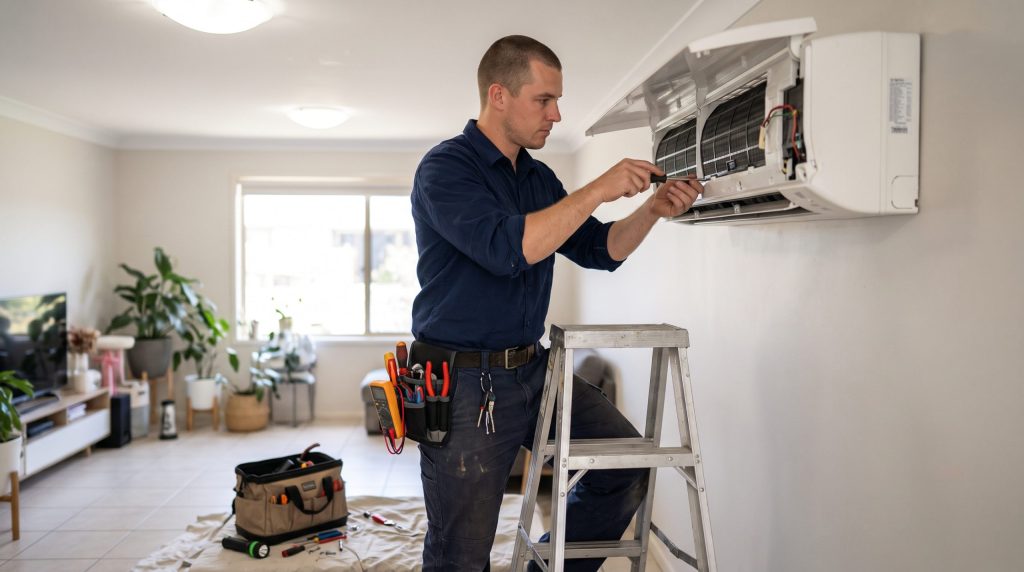
How to keep your AC and breaker from failing again
A new breaker won’t fix a failing capacitor, and a new capacitor won’t fix a worn breaker. Starting with a proper diagnosis keeps you from paying for the wrong repair. Most of these problems can also be caught early: a yearly tune-up that tightens electrical connections and measures amp draw spots trouble before it trips anything. Here’s what a professional AC tune-up checks. If your system seems to work harder every summer, an energy assessment verifies its performance, settings, and airflow. And if the breaker or panel does need work, keep in mind that panel upgrades in Bedford require a permit and a state-licensed contractor registered with the city.
If you can’t tell whether it’s the breaker or the AC, AC Repair DFW can help. Our licensed technicians serve Bedford and the surrounding DFW area, and they’ll test your AC and tell you whether the problem is the unit or the breaker. Schedule an AC diagnostic or request a free quote.