If you live in Bedford, TX, you already know how brutal the summers get. Your air conditioner is not just a luxury. It is a lifeline. So when your AC suddenly stops working after a thunderstorm or a neighborhood-wide power outage, it is more than just annoying. It is a real problem that needs a real answer fast.
One of the most common and most overlooked causes of HVAC failure is a power surge. Most homeowners do not even think about it. They assume the AC just gave out. But in many cases, the real culprit was a sudden spike in electrical voltage that quietly fried key components inside the system, leading to costly HVAC repair that could have been avoided with the right protection in place.
What Is a Power Surge, and Why Should You Care?
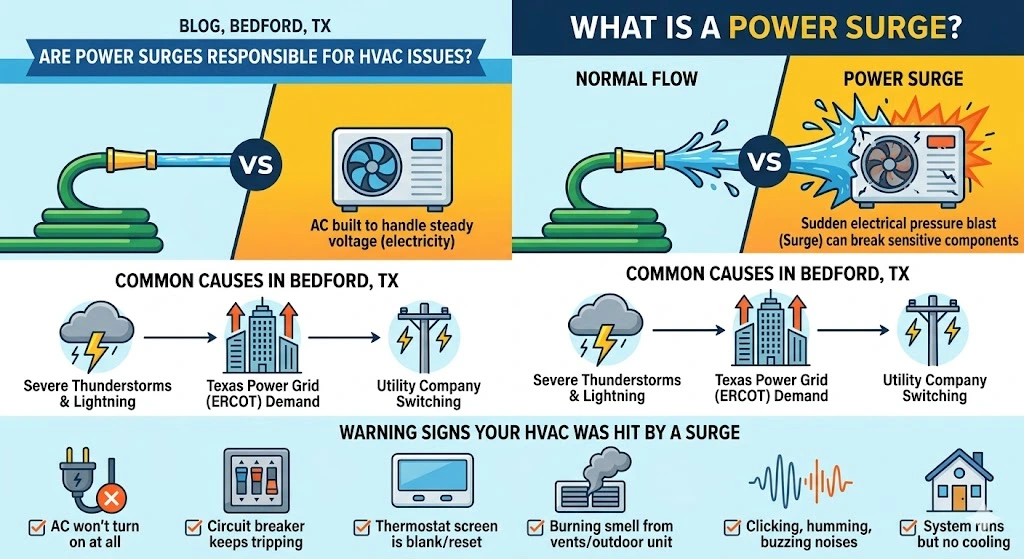
A power surge is a sudden spike in electrical voltage that moves through your home’s wiring. It only lasts a fraction of a second, but that is enough to cause serious damage to sensitive electronics, including your HVAC system.
Think of it like a garden hose. Your AC is built to handle a steady, normal flow of water (electricity). A power surge is like someone suddenly cranking the pressure up to full blast. The hose, or in this case, your AC components, cannot handle it, and something breaks.
In Bedford, TX, power surges happen more often than most people realize. Severe thunderstorms, lightning strikes, high-demand periods on the Texas power grid (ERCOT), and even utility company switching can all trigger surges. If your home is not protected, your HVAC system is at risk every single time the lights flicker.
For a deeper look at keeping your system safe when storms roll in, check out How to Avoid HVAC Issues During Severe Weather and get ahead of the damage before it starts.
7 Ways Power Surges Can Damage Your HVAC System
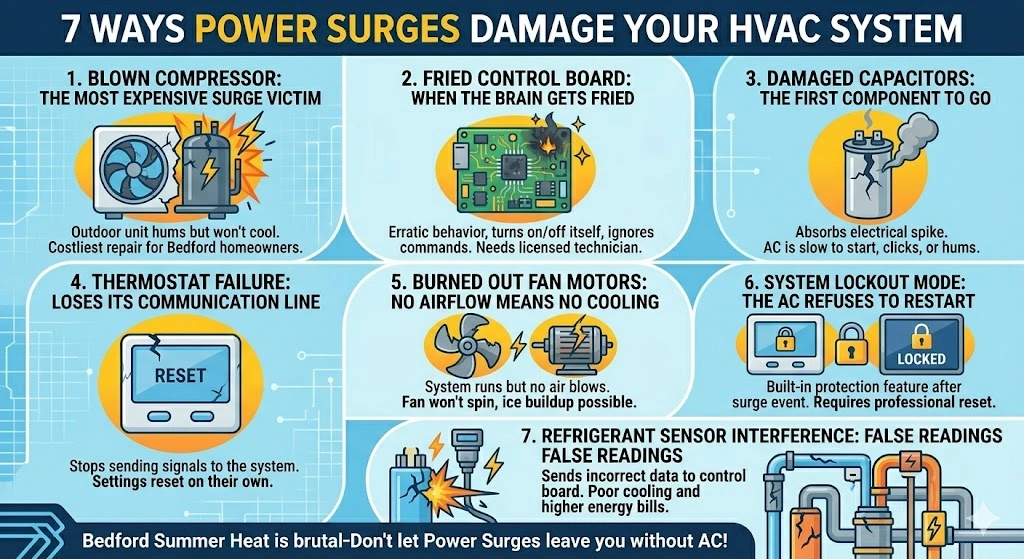
1. Fried Compressor: The Most Expensive Surge Victim
The compressor is the most expensive part of your air conditioner. It is responsible for pressurizing the refrigerant that cools your home. It is also very sensitive to electrical fluctuations.
When a power surge hits, the compressor motor can overheat or short out in seconds. A damaged compressor often means the entire outdoor unit needs to be replaced. This is one of the costliest repairs a Bedford HVAC technician will ever deliver to a homeowner.
Signs your compressor may have surge damage:
- The outdoor unit hums but does not cool
- The system trips the circuit breaker repeatedly
- The AC simply will not turn on at all
The compressor is not a DIY fix. It requires a licensed HVAC professional to properly diagnose and replace.
Storms can do more damage than what shows up right away, so read Can Severe Storms Cause Hidden HVAC Issues to find out what most homeowners miss after a bad weather event.
2. Blown Capacitors: The First Component to Go
Capacitors are small cylindrical components that help start and run the motors in your AC system. They store electrical energy and release it when needed to get the system going.
Power surges overload capacitors quickly. In fact, a capacitor is often the first thing to fail after a surge because it absorbs the brunt of the electrical spike. Capacitor replacement is one of the more affordable HVAC repairs available. However, a failed capacitor puts extra strain on the compressor. If it is not caught early, one small problem can turn into a much bigger and more expensive one.
Signs of a failed capacitor:
- The AC is slow to start up
- A clicking or humming sound comes from the unit
- The system shuts off randomly without completing a cooling cycle
North Texas humidity can put extra stress on already weakened components, so do not miss What HVAC Issues Does High Humidity Trigger to see how moisture makes a bad situation even worse.
3. Damaged Control Board: When the Brain of Your HVAC Gets Fried
Modern HVAC systems are essentially computers. They use a circuit board, sometimes called a control board, to manage every function, including temperature regulation, fan speed, and cooling cycles.
Circuit boards are extremely vulnerable to electrical surges. Even a small voltage spike can corrupt the board’s programming or burn out its components entirely. When this happens, the system may behave erratically, turning on and off by itself, ignoring thermostat commands, or not responding at all.
Replacing a control board is a job for a licensed technician. In Bedford, where summer heat makes a malfunctioning system a serious health concern, this is not a repair to delay or attempt without proper training.
4. Thermostat Failure: When Your AC Loses Its Communication Line
Your thermostat is the brain that tells your HVAC what to do. But if a power surge corrupts or damages the thermostat, especially a smart thermostat, it can stop sending signals to the system altogether.
You might notice the screen goes blank, settings reset on their own, or the system simply does not respond when you adjust the temperature. Many homeowners replace their thermostat, thinking it is a battery issue, only to discover the real problem was a surge that damaged the internal wiring or programming.
What to check first: Make sure the thermostat screen is lit, the settings are intact, and that the system responds to manual adjustments before assuming the problem lies elsewhere.
5. Burned Out Fan Motors: No Airflow Means No Cooling
Your HVAC system has at least two fans. One is inside the air handler, and one sits in the outdoor condenser unit. Both rely on motors that are sensitive to voltage changes.
A power surge can burn out motor windings, damage bearings, or cause the motor to seize up completely. When the fan motor fails, air stops moving through the system. This can cause the evaporator coil to freeze over, yes, even in a Texas summer, or cause the system to overheat and shut down permanently.
Signs of a failed fan motor:
- The system sounds like it is running, but no air is blowing through the vents
- The outdoor unit is running, but the fan blades are not spinning
- Ice buildup is visible on the refrigerant lines or the indoor unit
6. Sensor and Refrigerant Line Interference
The refrigerant itself is not directly affected by electrical surges. However, the sensors and components that monitor refrigerant pressure and temperature can be damaged.
Surge damage to these sensors sends incorrect readings to the control board. This causes the system to behave as if it is low on refrigerant, even when it is not. The result is poor cooling, higher energy bills, and unnecessary service calls where technicians search for a refrigerant leak that does not exist.
This type of surge damage is tricky because the symptoms look like a completely different problem. A trained HVAC technician in Bedford will know how to run electrical diagnostics to rule out surge damage before chasing other causes.
7. System Lockout Mode: When the AC Refuses to Restart
Many HVAC systems have a built-in protection feature that shuts everything down when it detects an abnormal electrical event. This is called lockout mode. After a power surge, your system may enter lockout and refuse to restart even after power is fully restored.
This is a safety feature, not a failure. But most homeowners do not know how to properly reset it without risking further damage. Attempting a manual reset incorrectly or repeatedly can make the situation worse and potentially void any remaining warranty on the unit.
Warning Signs Your HVAC Was Hit by a Power Surge
Here is a quick checklist every Bedford homeowner should run through right after a storm or power outage:
- AC will not turn on at all after the power is restored
- The circuit breaker keeps tripping when the AC tries to run
- The thermostat screen is blank, or all settings were erased
- A burning smell is coming from the vents or the outdoor unit
- Strange noises such as clicking, humming, or buzzing from the system
- The system runs, but the house does not cool down
- Energy bills suddenly spike after a storm event
If any of these signs show up, stop attempting to restart the system. Repeated restart attempts after surge damage can cause additional and more expensive harm to the components that are still functioning.
How to Protect Your HVAC System From Power Surges in Bedford, TX
Prevention is always cheaper than repair. Here are practical steps every Bedford homeowner can take right now to reduce the risk of surge-related HVAC damage.
Install a Whole-Home Surge Protector
This is the single most effective step available. A whole-home surge protector installs directly at the electrical panel and acts as the first line of defense for every appliance in the house, including the HVAC system. The average cost of this protection is far less than replacing a compressor or control board.
Add a Dedicated HVAC Surge Protector
Even with whole-home protection in place, adding a dedicated surge protector directly to the HVAC unit provides an extra layer of defense. These devices are designed specifically for the voltage requirements of air conditioners and heat pumps and absorb spikes before they reach the system.
Turn the HVAC Off During a Storm
When a major storm is approaching, which happens regularly in Bedford and the broader DFW area, switch the thermostat to the OFF position before the storm arrives. Do not just raise the set temperature. Turn the system completely off. This simple step reduces the risk of surge damage while the system is actively running.
Schedule Annual HVAC Maintenance
A licensed HVAC technician can inspect all electrical components, including capacitors, contactors, wiring, and circuit boards. Catching early signs of wear before a surge finishes them off is one of the most cost-effective things a homeowner can do. Annual tune-ups are especially important in Bedford, given the extreme demand placed on cooling systems from May through September every year.
Have Your Electrical Panel Inspected
Older or outdated electrical panels are more vulnerable during surge events. If your Bedford home still has an older panel, it may not handle modern power demands well. A licensed electrician can assess whether an upgrade is warranted before the next storm season.
Why Bedford, TX Homeowners Face a Higher Risk
Bedford sits right in the heart of the DFW Metroplex, an area known for severe spring and summer thunderstorms. Lightning strikes in this region are common. The Texas power grid managed by ERCOT has experienced high-stress events that have led to brownouts and voltage fluctuations. And the heat in North Texas pushes HVAC systems to their absolute limits from late spring through early fall.
All of that adds up to a higher-than-average risk of surge-related HVAC damage for residents in Bedford and surrounding communities like Hurst, Euless, and Colleyville. Knowing what to look for and having a trusted local AC repair company ready to call is not paranoia. It is just smart homeownership in North Texas.
Power Surges Are a Real Threat to Your AC
Power surges are silent attackers. They do not give a warning before they hit, and sometimes you do not even realize one occurred until the AC stops working in the middle of a scorching Bedford afternoon.
The good news is that surge damage is largely preventable with the right protection in place. And when damage does happen, catching it early with help from a licensed HVAC technician makes a significant difference in the final repair cost, and in some cases, determines whether a targeted fix is still possible or whether a full HVAC replacement becomes the only option.
Do not wait for the next storm to think about this. Take steps to protect the system now, know the warning signs, and keep a trusted local AC repair professional’s number handy. In Bedford, TX, a working air conditioner is not optional, and protecting it from power surges is one of the smartest investments a homeowner can make.
Get Your AC Inspected by a Trusted Local Expert
When it comes to AC repair in the DFW area, experience and local knowledge matter. AC Repair DFW has handled surge-related HVAC damage of every kind, from blown capacitors to failed compressors, and brings the hands-on expertise needed to get your system running right the first time. Serving Bedford and the surrounding communities, we deliver fast response, honest diagnostics, and quality repairs that every homeowner deserves, especially in the middle of a Texas summer. Contact us today or give us a call to schedule your inspection and protect your home before the next storm hits.