Your AC is freezing up in summer because something is either blocking airflow across the evaporator coil or lowering the refrigerant pressure, which drops the coil below freezing and turns the condensation on it into ice. The most common causes are a dirty air filter, a dirty coil, or low refrigerant from a leak. Less often it’s a weak blower, closed vents, running the AC on a cool night, or a failing expansion valve, and occasionally it traces back to a mistake in the original HVAC installation. The moment you see ice, turn the cooling off and run the fan to thaw it, because running a frozen system can destroy the compressor and turn a simple fix into a major HVAC repair. Then work down the list below to find the real cause.
Key takeaways
- A frozen coil almost always comes down to one of two things: restricted airflow or low refrigerant. Find which and you find the fix.
- The single most common cause we see is a dirty air filter, followed by a dirty evaporator coil. Both are about airflow.
- Low refrigerant always means a leak. Never just recharge it; the leak has to be found and repaired.
- The instant you spot ice, turn the AC off and set the fan to “on” to thaw it. Running a frozen system risks the compressor, the most expensive part to replace.
- If it refreezes after thawing, or you suspect refrigerant, stop and call a pro. Repeated freezing has a root cause that won’t fix itself.
- Never touch refrigerant lines or the capacitor yourself. Those are call-a-pro items every time.
1. A dirty air filter is choking the coil

Symptom: Ice on the indoor coil or the refrigerant line, weak airflow, and no cold air until it thaws.
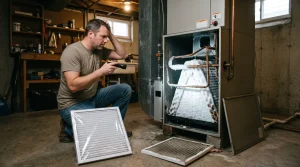
Most likely cause: A clogged filter. It’s the number one reason we get frozen-coil calls in a Bedford summer. When the filter blocks airflow, the coil can’t pull in enough warm air, so its temperature drops below freezing and moisture on it turns to ice.
Fix steps: Turn the AC off and set the fan to “on” to thaw the coil, which can take a few hours. While it thaws, replace the filter if light won’t pass through it. Once fully thawed, restart in cool mode.
Call a pro if: It freezes again soon after, which means airflow isn’t the only issue.
How to fix an AC freezing up from a dirty filter
A fresh filter is the cheapest fix and clears up a large share of freeze-ups. For the how-to, see our guide on how to clean an HVAC filter, and for the bigger picture read our master guide, Why Your AC Struggles in Texas Heat—and How to Fix It.
2. The evaporator coil itself is dirty
Symptom: Repeated freezing even with a clean filter, gradually weaker cooling, and sometimes a musty smell.
Most likely cause: A dirty evaporator coil. Over time a fine film builds up on the coil and acts like insulation, so it can’t absorb heat from the air. That drops its surface temperature below freezing and it ices over.
Fix steps: Thaw the coil first (fan on, cooling off). Light surface dust on an accessible coil can be gently vacuumed, but the coil sits inside sealed ductwork, so a thorough, safe cleaning is a professional job.
Call a pro if: Cooling is down and the filter is clean, which usually means the coil needs professional cleaning.
Why a dirty evaporator coil keeps freezing your AC
Coil buildup is a sneaky, recurring cause of freeze-ups. Learn to spot it early with our guide on dirty evaporator coil symptoms.
3. Low refrigerant from a leak
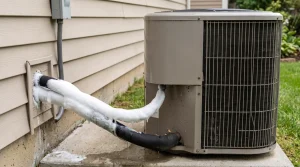
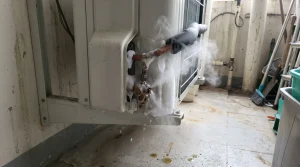
Symptom: Ice specifically on the copper refrigerant line at the outdoor unit, the AC running all day, and only mildly cool air.
Most likely cause: Low refrigerant. When the charge is low, pressure in the coil drops, and lower pressure means a lower temperature, so the coil freezes. Your system doesn’t use up refrigerant, so a low charge always means a leak.
Fix steps: This is not a DIY fix. Refrigerant is regulated and requires EPA certification and proper gauges. Turn the system off to protect the compressor and schedule a technician to find the leak, repair it, and recharge to spec.
Call a pro if: Always, for anything refrigerant-related.
Why does low refrigerant make an AC coil freeze
Low charge is one of the top freeze-up causes and it never fixes itself. See why your air conditioner is blowing warm air, a common companion symptom of low refrigerant. A dirty outdoor unit can also mimic these symptoms, so it’s worth checking our cluster Why Is My Outdoor AC Unit Not Cooling? 6 Signs Your Condenser Coils Are Dirty.
4. A weak or failing blower fan
Symptom: Very weak airflow from the vents even with a clean filter, and a coil that keeps icing over.
Most likely cause: A struggling blower motor. The blower moves warm indoor air across the coil. If it’s failing or running slow, not enough air reaches the coil and it freezes, just like a dirty filter would cause.
Fix steps: Confirm the filter is clean and all vents are open first. If airflow is still weak, the blower motor or its capacitor may be failing, which is a professional diagnosis and repair.
Call a pro if: Airflow stays weak with a clean filter and open vents, pointing to the blower or its capacitor.
How to tell if a bad blower is freezing your AC
A weak blower mimics an airflow blockage. Our guides on an AC fan not working and what a capacitor does explain the parts involved.
5. Closed or blocked vents restricting airflow
Symptom: Freezing that started after furniture was moved or vents were closed in unused rooms.
Most likely cause: Too little return or supply airflow. Closing or blocking too many vents raises pressure in the ducts and starves the coil of the warm air it needs, so it drops below freezing.
Fix steps: Thaw the coil, then open all supply vents and clear anything blocking return grilles (rugs, furniture, drapes). Leave the vents open even in unused rooms.
Call a pro if: The coil freezes with the filter clean and all vents open, which points to a deeper airflow or refrigerant issue.
How blocked vents cause a frozen AC coil in summer
Restricting airflow to “save energy” often backfires into a freeze-up. If it keeps happening despite open vents, see our related cluster, Why Won’t My AC Cool Below a Certain Temperature in 100-Degree Texas Heat? 6 Reasons.
6. Running the AC when it’s too cool outside
Symptom: Ice appears in the morning after the AC ran overnight, especially on the rare cooler Texas night below the mid-60s.
Most likely cause: Low outdoor temperature. AC systems are designed to run when it’s warm out. When the outdoor air dips too low and the system keeps cooling, the coil pressure and temperature can drop far enough to freeze.
Fix steps: On unusually cool nights, switch the system to “fan only” or turn it off. This is more of a spring and fall issue in Bedford, but early-summer cool snaps can trigger it.
Call a pro if: Freezing happens on genuinely hot days, since then the cause is something else on this list.
Why running your AC on a cool night freezes the coil
This one is easy to fix once you know it. For smart summer scheduling that avoids it, our master guide, Why Your AC Struggles in Texas Heat—and How to Fix It, covers healthy run patterns.
7. A stuck expansion valve or metering device
Symptom: Persistent freezing that returns no matter how clean the filter and coil are, sometimes with uneven cooling.
Most likely cause: A failing metering device. The expansion valve (or metering device) controls how much refrigerant enters the coil. If it sticks or fails, it can flood or starve the coil and drop its temperature below freezing.
Fix steps: There’s no DIY fix. This is a sealed-system component that requires gauges and refrigerant handling to diagnose and replace, so it’s a professional repair. On an older system, a technician may also suggest an energy assessment to see whether the aging equipment is worth fixing at all.
Call a pro if: Always. If you’ve ruled out airflow and the coil still freezes, this is a likely culprit. When the metering device fails on a unit that’s already near the end of its life, HVAC replacement is often the more cost-effective path than repeated sealed-system repairs.
How a bad expansion valve causes a frozen evaporator coil
A faulty metering device is one of the trickier freeze-up causes to pin down. If the system is also short cycling, see our guide on AC short cycling.
DIY-safe vs. call-a-pro: a frozen AC coil

| Cause | Safe to DIY | Call a pro |
| Dirty air filter | Yes, thaw and replace | If it refreezes |
| Dirty evaporator coil | Light surface dust only | Full coil cleaning |
| Low refrigerant | No, never | Always, requires EPA certification |
| Weak blower fan | Check filter/vents only | Blower or capacitor repair |
| Closed or blocked vents | Yes, open them all | If it freezes with vents open |
| AC running on a cool night | Yes, switch to fan/off | If freezing on hot days |
| Stuck expansion valve | No | Always |
The bottom line for Bedford homeowners
A frozen AC coil is your system telling you it can’t breathe or it’s low on refrigerant. The first move is always the same: turn the cooling off, run the fan to thaw the ice, and check the filter and vents. That solves most freeze-ups. But if it ices up again, or you see frost on the outdoor refrigerant line, stop there. Repeated freezing has a root cause, and running the system through it is the fastest way to a compressor failure.
If your AC keeps freezing up after you’ve handled the basics, AC Repair DFW can help. Book same-day service or get a free quote and a licensed technician will find the real cause before it costs you a compressor.