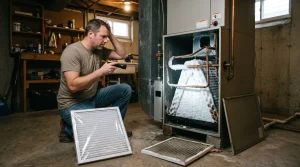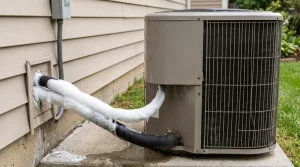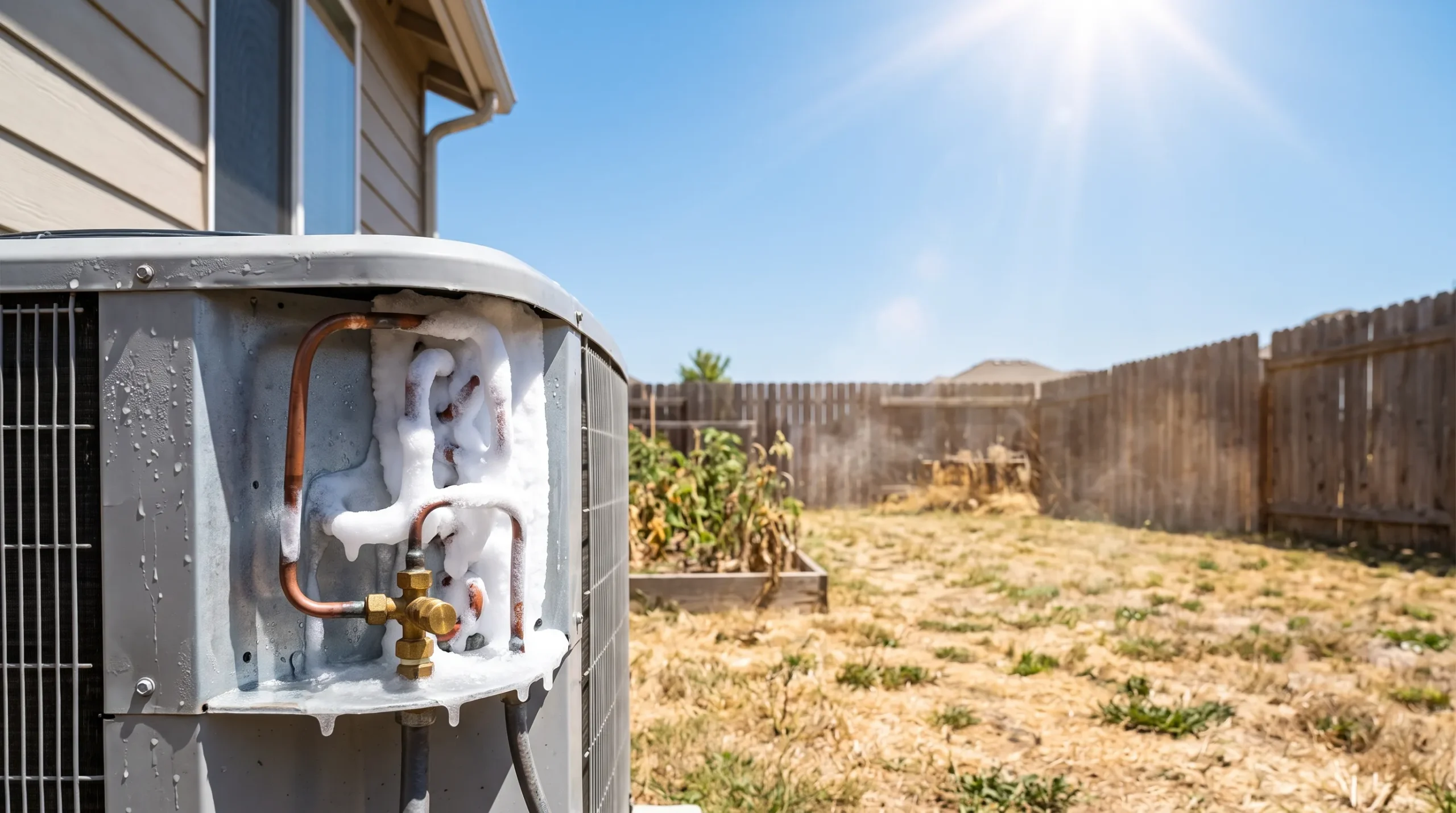
Your AC freezes up in 100-degree heat because the coil is not getting enough warm air across it, or the refrigerant pressure has dropped too low. Either one pulls the coil’s surface temperature below 32 degrees, and the humidity condensing on it turns to ice. The outdoor temperature is not what freezes the coil. In fact, extreme heat makes it worse, because the system runs nearly nonstop and never gets an off cycle long enough to melt the frost that forms. That is why a marginal filter or a slow refrigerant leak that caused no trouble in May turns into a solid block of ice in August. The moment you see ice, switch the cooling off and set the fan to “on” so it can thaw. Running a frozen system is the fastest way to destroy a compressor.
Key takeaways
- A frozen coil in triple-digit heat is almost always airflow or refrigerant. Find which one and you have found the repair.
- Heat does not cause the freeze, but it exposes it. Continuous runtime removes the off cycles that used to melt the frost before you noticed it.
- The most common cause we see is a dirty or too-restrictive air filter, followed by a dirty evaporator coil.
- Low refrigerant always means a leak. Recharging without repairing the leak is money spent twice.
- Turn the cooling off and run the fan the moment you spot ice. A thaw takes a few hours. Never chip or scrape the ice.
- If it refreezes after a full thaw, stop troubleshooting and call a technician. Repeat freezing has a root cause that does not resolve on its own.
- Refrigerant lines and capacitors are never DIY. Both can injure you, and refrigerant work is federally regulated.
1. A dirty air filter is starving the coil
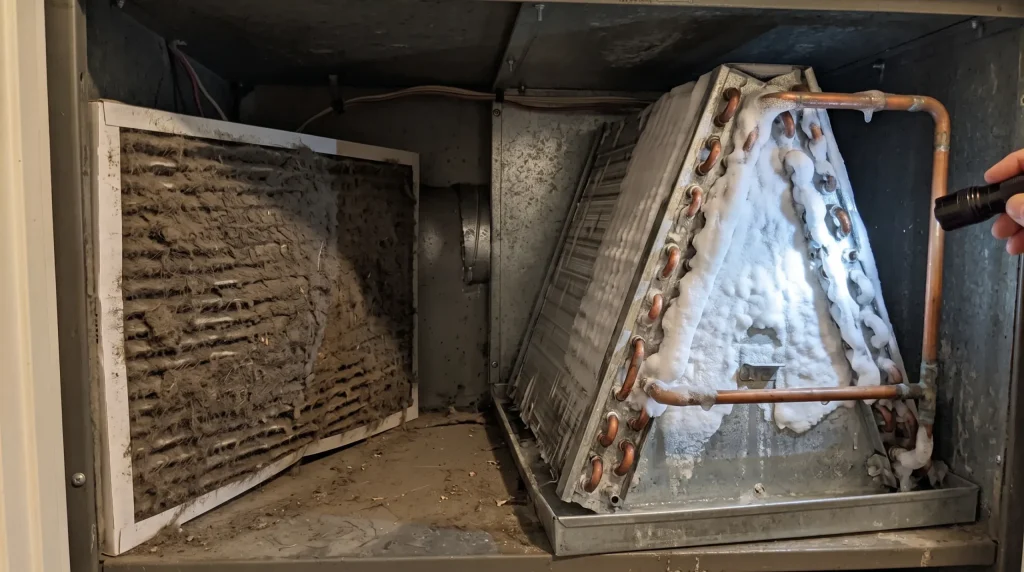
Symptom: Ice on the indoor coil or the copper line, weak airflow from the vents, and no cold air until it thaws.
Most likely cause: A clogged filter. This is the number one reason we get frozen coil calls during a Bedford summer. The evaporator coil needs a steady stream of warm indoor air to absorb heat from. When the filter blocks that air, the coil has nothing to warm it, its surface drops below freezing, and the moisture on it turns to ice.
Fix steps: Turn the cooling off at the thermostat and set the fan to “on.” Pull the filter and hold it up to a light. If light will not pass through, replace it. Leave the fan running until every trace of ice is gone, which usually takes a few hours, then restart in cool mode.
Call a pro if: It freezes again within a day or two of a fresh filter. That means airflow was a symptom, not the cause.
How to fix an AC freezing up from a dirty filter in Texas heat
A fresh filter is the cheapest fix in the entire list and it resolves a large share of freeze-ups. In July and August, when the system may run eighteen hours a day, check the filter monthly instead of quarterly. Our guide to cleaning an HVAC filter walks through the process, and the U.S. Department of Energy publishes the same guidance on filter and coil maintenance for homeowners.
2. The evaporator coil itself is dirty
Symptom: Repeated freezing even with a clean filter, cooling that has weakened gradually over a season or two, and sometimes a musty smell when the system kicks on.
Most likely cause: A dirty evaporator coil. Even a good filter lets a fine film through over the years. That film sits on the coil and insulates it, so it cannot absorb heat from the passing air. The result is the same as a blocked filter: a coil that runs too cold and ices over.
Fix steps: Thaw the coil completely first, with the cooling off and the fan on. Light surface dust on an accessible coil can be vacuumed gently with a soft brush attachment. The coil itself sits inside sealed ductwork, though, and a real cleaning means opening the air handler, so that part is a professional job.
Call a pro if: Cooling is noticeably down and the filter is clean. That combination almost always points at the coil.
Why a dirty evaporator coil freezes your AC in summer
Coil buildup is slow and easy to miss because the decline happens over years, not days. Learn to catch it early with our guide on dirty evaporator coil symptoms. An annual AC tune-up is what keeps this one from ever becoming a freeze-up.
3. Low refrigerant from a leak
Symptom: Ice on the copper refrigerant line at the outdoor unit, the system running all day without reaching the setpoint, and air from the vents that is only mildly cool.
Most likely cause: A low refrigerant charge. Refrigerant does not get consumed the way fuel does. It circulates in a sealed loop, so if the charge is low, there is a leak. When pressure in the coil drops, the refrigerant’s boiling point drops with it, and the coil gets cold enough to freeze the humidity condensing on its surface.
Fix steps: There is no homeowner fix here. Refrigerant handling requires federal certification and proper gauges, and the leak has to be located and repaired before any recharge. Shut the system off to protect the compressor and schedule a technician.
Call a pro if: Always, for anything involving refrigerant.
Why low refrigerant makes an AC coil freeze in hot weather
Low charge is one of the top three causes we find in August, and it never resolves itself. The full symptom list is in our cluster guide, How Do I Know if My AC Is Low on Refrigerant? 7 Signs of a Freon Leak. A low charge also commonly shows up as an air conditioner blowing warm air, so the two symptoms often arrive together. Refrigerant is regulated by the U.S. Environmental Protection Agency, and only a certified technician may legally handle it.
4. Closed or blocked vents and return grilles
Symptom: Freezing that started after vents were closed in unused rooms, or after furniture, rugs, or drapes moved in front of a return grille.
Most likely cause: Too little air reaching the coil. Closing supply vents does not save money the way people expect. It raises static pressure in the duct system and reduces the total volume of air moving across the coil, which produces the same freeze as a blocked filter.
Fix steps: Thaw the coil, then open every supply vent in the house, including the ones in rooms nobody uses. Pull furniture and rugs clear of return grilles. Give the return at least a couple of feet of open space.
Call a pro if: It still freezes with a clean filter and every vent open. At that point the restriction is inside the system, not in the room.
How blocked vents cause a frozen AC coil during a heat wave
This is one of the few causes on the list that is fully DIY, and it costs nothing to rule out. It matters more in triple-digit weather, when the system is running continuously and even a modest airflow restriction compounds hour after hour.
5. A filter that is too restrictive for your system
Symptom: Freezing that began shortly after switching to a thicker, higher-rated filter, with weak airflow despite the filter being visibly clean.
Most likely cause: Filter resistance. A high-MERV or HEPA-style filter traps finer particles, but it also fights airflow harder. Many residential air handlers were never designed for that much static pressure. The filter is spotless, and the coil is still starving.
Fix steps: Go back to the filter rating your system’s manufacturer specifies. If you need better filtration for allergies, the answer is usually a larger filter housing with more surface area, not a denser filter in the same slot.
Call a pro if: You want better air quality without the airflow penalty. Sizing that correctly takes a static pressure reading.
Why a clean filter can still freeze your AC coil
This is the cause homeowners almost never suspect, because the filter looks brand new. Our comparison of cheap versus expensive air filters explains the tradeoff, and if you have already ruled out the obvious, read Why Does My AC Keep Freezing Up After I Changed the Filter? 5 Causes for the rest of the diagnostic path.
6. A weak or failing blower motor
Symptom: Very weak airflow at every vent even with a clean filter and open registers, sometimes with a hum or a delay when the system starts.
Most likely cause: A blower motor or its capacitor going bad. The blower is what pushes warm indoor air across the coil. When it slows down or struggles to start, the coil gets less air than it needs and ices over, exactly as if something were blocking the duct.
Fix steps: Confirm the filter is clean and every vent is open first, since those mimic the same symptom. If airflow is still weak, the motor or capacitor needs a professional diagnosis. Capacitors hold a dangerous charge even with the power off, so this is not a DIY test.
Call a pro if: Airflow stays weak after you have ruled out the filter and the vents.
How to tell if a bad blower motor is freezing your AC
A dying blower looks identical to a blocked duct from the thermostat. Our guides on an AC fan not working and what a capacitor does cover the parts involved and what the failure sounds like.
7. Restricted, leaky, or undersized ductwork
Symptom: Some rooms never cool, the system runs constantly, energy bills spike in July, and the coil ices up during the hottest stretch of the year.
Most likely cause: A duct system that cannot deliver the airflow the equipment needs. In this area, ducts usually run through attics that pass 130 degrees. Crushed flex duct, disconnected runs, or a return that was undersized at installation all reduce airflow across the coil.
Fix steps: Seal accessible joints with mastic or foil tape, never cloth duct tape, which fails in attic heat. Weatherstrip the attic hatch. A full duct evaluation with a pressure test is a professional job, but it has a strong payback in Texas.
Call a pro if: Rooms stay uneven after basic sealing, or the freezing continues with clean filters and open vents.
Why bad ductwork freezes an AC coil in Texas summers
Duct problems often trace back to the original HVAC installation rather than to anything that wore out. If your bills have climbed alongside the freezing, an energy assessment will show whether the ducts and insulation are the real cost driver.
8. The thermostat is set so low the system never cycles off
Symptom: Ice appears during the hottest week of the year, on a system that seemed fine all spring, with the thermostat set to 68 or lower.
Most likely cause: No off cycle. Air conditioners are designed to reach the setpoint and shut down, and that pause is when normal frost on the coil melts away. When it is 105 outside and the thermostat is set to 68, the system may never reach the setpoint, so it runs for hours without a break, and frost accumulates into ice.
Fix steps: Raise the setpoint to something the equipment can actually reach. A system is generally built to pull indoor temperature roughly 18 to 22 degrees below the outdoor temperature, so on a 105-degree afternoon, low 80s is the realistic floor for many homes. Setting it lower does not cool faster. It only guarantees continuous runtime.
Call a pro if: The system cannot hold a reasonable setpoint on a hot afternoon, which points at capacity, charge, or airflow rather than the thermostat.
Why running your AC nonstop in 100-degree heat freezes the coil
This is the cause that surprises people most, because nothing is broken. It is also why freeze-ups cluster during heat waves. Our related guide on why your AC will not cool below a set temperature in 100-degree Texas heat covers what a healthy system can and cannot do on the worst days of summer, and high humidity adds moisture that makes any freeze form faster.
9. A failing expansion valve or metering device
Symptom: Persistent freezing that comes back no matter how clean the filter and coil are, sometimes with uneven cooling or a system that short cycles.
Most likely cause: A stuck or failing metering device. The expansion valve controls how much refrigerant enters the coil. When it sticks, it either floods the coil or starves it, and both conditions can drive the coil temperature below freezing.
Fix steps: None at home. This is a sealed-system component that requires gauges, refrigerant recovery, and certification to diagnose and replace.
Call a pro if: Always. Once airflow and charge have been ruled out, this is the most likely remaining culprit.
How a bad expansion valve causes a frozen AC line
A failing metering device often shows itself as ice forming on the copper line outside rather than on the indoor coil, which is a useful clue. That pattern is covered in Why Is the Pipe Outside My AC Frozen? 6 Causes of Ice on the Copper Line. If the system is also short cycling, the two symptoms usually share a cause. On a system past twelve or fifteen years, a sealed-system repair is worth weighing against HVAC replacement before you spend the money.
DIY-safe vs. call-a-pro: a frozen AC coil in 100-degree heat
|
Cause |
Safe to DIY |
Call a pro |
|
Dirty air filter |
Yes. Thaw and replace |
If it refreezes within days |
|
Dirty evaporator coil |
Light surface dust only |
Full coil cleaning |
|
Low refrigerant from a leak |
No, never |
Always. Federally regulated |
|
Closed or blocked vents |
Yes. Open them all |
If it freezes with vents open |
|
Too-restrictive filter |
Yes. Return to spec rating |
To size better filtration safely |
|
Weak blower motor |
Rule out filter and vents only |
Motor or capacitor repair |
|
Restricted or leaky ducts |
Seal reachable joints |
Duct pressure test and redesign |
|
Thermostat set too low |
Yes. Raise the setpoint |
If it cannot hold a fair setpoint |
|
Failing expansion valve |
No |
Always |
The bottom line for Bedford homeowners

A frozen coil in the middle of a Texas heat wave is your system telling you it cannot breathe, or that it is losing refrigerant. The first move never changes: turn the cooling off, run the fan until the ice is completely gone, then check the filter and the vents. That resolves most freeze-ups. But if it ices over again, or you see frost creeping along the copper line outside, stop there. Every hour a frozen system runs is an hour of liquid refrigerant working its way back toward a compressor that costs more than every other repair on this list combined.
If your AC keeps freezing up after you have handled the basics, AC Repair DFW can find the real cause. Book same-day service or request a free quote, and a licensed technician will diagnose it properly before it turns into an emergency HVAC repair on the hottest day of the year.