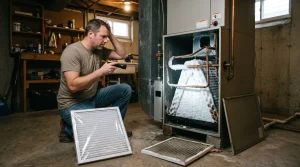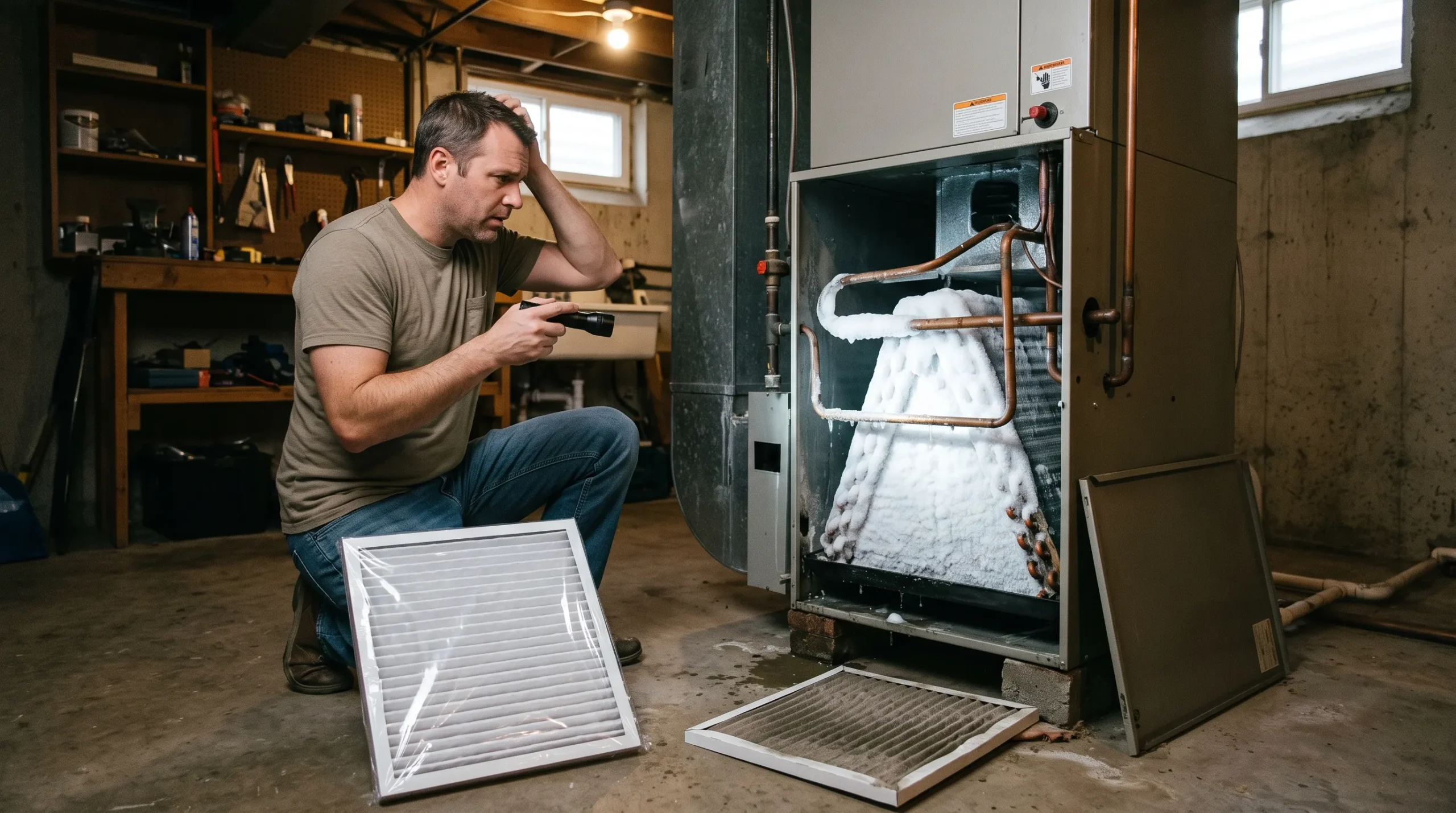
If your AC froze again after a fresh filter, the most common explanations are that the new filter is too restrictive for your system, that you restarted before the ice had fully melted, that the evaporator coil behind the filter is dirty, that airflow is blocked somewhere the filter never touched, or that the refrigerant charge is low. The filter change was not wasted. It eliminated the single most common cause, which means the answer is now one of five, not one of nine. Work them in the order below, because the first two are free to check and the last one is the expensive one to ignore.
Key takeaways
- A filter change that does not fix the freeze is diagnostic information, not a failure. It rules out the leading cause.
- A brand new filter can cause a freeze if it is too dense for your air handler. Clean does not mean unrestricted.
- Restarting before the coil is fully thawed is the most common self-inflicted repeat. Leftover ice seeds the next freeze.
- The coil sits behind the filter and collects a film over the years. A clean filter does not clean a dirty coil.
- Low refrigerant always means a leak, and it never resolves on its own.
- Two freezes in one season means stop troubleshooting and book a diagnosis. Repeat freeze cycles are how a cheap fix becomes a compressor.
What the filter change already ruled out
Before you work the list, it is worth knowing what you have proven. A frozen evaporator coil has exactly two root causes: not enough warm air moving across it, or refrigerant pressure that has fallen too low. That is the whole universe.
A clean filter eliminates the most common airflow restriction, so if the system froze again, the restriction is either downstream of the filter, inside the equipment, or the problem was never airflow at all. That is a genuinely useful narrowing, and it is why we ask homeowners to change the filter before we roll a truck.
1. The new filter is too restrictive for your system
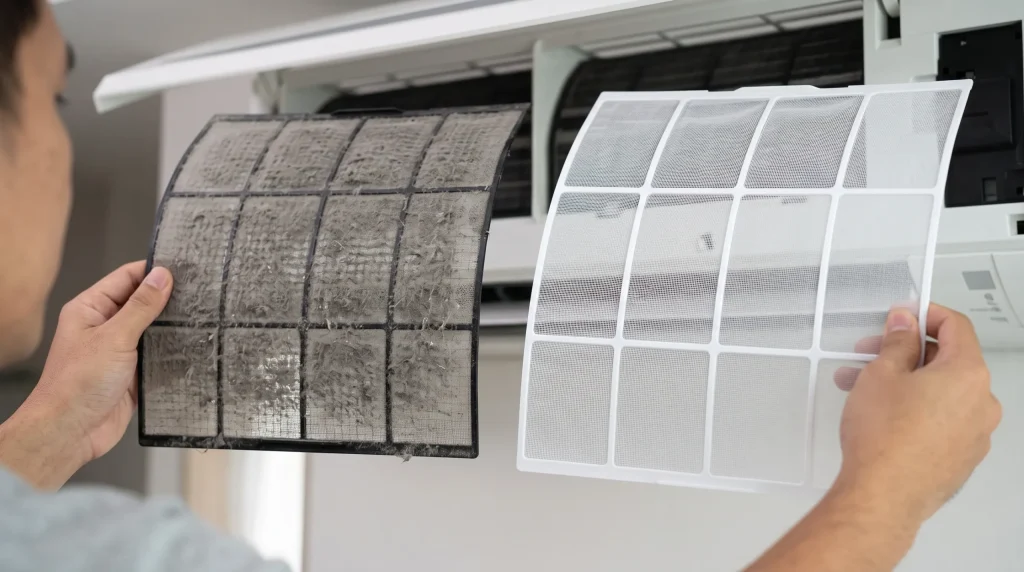
Symptom: The freeze started shortly after switching to a thicker, higher-rated, or more expensive filter. Airflow at the vents feels weak even though the filter is visibly spotless.
Most likely cause: Filter resistance. A high-MERV or HEPA-style filter traps finer particles by being denser, and density fights airflow. Many residential air handlers were never designed for that much static pressure. The filter is clean, and the coil is still starving, which produces the identical freeze a filthy filter would.
Fix steps: Thaw the system completely, then go back to the filter rating your equipment manufacturer specifies, which is usually printed inside the access panel or in the manual. Also check the arrow. A filter installed backward restricts more than one installed correctly, and it is a surprisingly common cause of a freeze that begins the same week as a filter change.
Call a pro if: You want better filtration without the airflow penalty. That usually means a larger filter housing with more surface area, not a denser filter in the same slot, and sizing it correctly requires a static pressure reading.
Why a clean filter can still freeze your AC coil
This is the cause homeowners almost never suspect, because everything looks right. Our comparison of cheap versus expensive air filters covers the tradeoff between filtration and airflow, and ENERGY STAR’s guidance on HVAC filters explains why a monthly check matters more than a premium rating. If you are not sure how to inspect what you have, start with our guide to cleaning an HVAC filter.
2. You restarted before the coil was fully thawed
Symptom: It froze again within hours of coming back on, or it seemed to work briefly and then quit cooling the same afternoon.
Most likely cause: Leftover ice. This is the most common self-inflicted repeat we see, and it is entirely understandable, because nobody wants to sit in a hot house waiting on a coil. But any ice still on the coil when you restart blocks airflow immediately, and the freeze rebuilds from there. The system never gets a fair test.
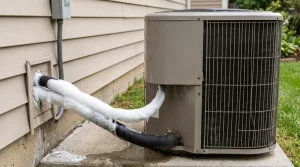
Fix steps: Cooling off, fan on, and wait until you are certain. Look at the copper lines at the outdoor unit as well as the indoor coil, because the line can hold ice after the coil looks clear. Then run it and watch closely for the first hour. Never chip, scrape, or pour hot water on the ice. Coil walls are thin, and a puncture turns a free fix into a refrigerant leak repair.
Call a pro if: A full thaw plus a clean filter still ends in a freeze. At that point you have properly tested the easy causes and the answer is further down.
How long to wait before restarting a frozen AC
Two to four hours is typical with the fan running, though a heavy build can take most of a day. In a Texas summer the temptation to rush is strong, and the National Weather Service records for this area explain why: the days you most need the system are exactly the days it has been running long enough to build serious ice. One more thing to watch during a thaw is water, since melt can outrun the drain pan. Our guide on an AC unit leaking water inside the house covers what to check.
3. The evaporator coil itself is dirty
Symptom: Repeated freezing with a correct, clean filter. Cooling has weakened gradually over several seasons rather than suddenly, and sometimes there is a musty smell when the system starts.
Most likely cause: Buildup on the coil. Even a good filter lets a fine film through over years, and that film sits on the coil acting as insulation. The coil cannot absorb heat from the passing air, so its surface drops below freezing. A new filter does nothing about a coil that is already coated.
Fix steps: Thaw completely first. Light surface dust on an accessible coil can be vacuumed gently with a soft brush. The coil itself sits inside sealed ductwork, so a real cleaning means opening the air handler, which is a professional job and not one worth improvising on.
Call a pro if: Cooling is noticeably down and the filter is clean and correctly rated. That combination points at the coil more reliably than any other symptom pair.
Why a dirty evaporator coil keeps freezing your AC
Coil fouling is the most common answer once the filter is ruled out, and it is the reason this list exists. Learn the early warning signs in our guide on dirty evaporator coil symptoms. For the full picture of how coil fouling sits among every other freeze cause, see our master guide, Why Does My AC Freeze Up When It’s 100 Degrees Outside? 9 Causes. A coil cleaning falls under routine HVAC repair work and an annual AC tune-up prevents it from getting this far.
4. Airflow is blocked somewhere the filter never touched
Symptom: Weak airflow at some or all vents, rooms that never cool evenly, and freezing that continues despite a correct filter and a full thaw.
Most likely cause: A restriction elsewhere in the air path. Closed supply vents in unused rooms, furniture or rugs against a return grille, crushed flex duct in a hot attic, a disconnected duct run, an undersized return, or a failing blower motor that no longer moves the air it should. Any of these starves the coil the same way a dirty filter does, and none of them are visible from the thermostat.
Fix steps: Open every supply vent, including the ones in rooms nobody uses. Pull furniture, rugs, and drapes at least two feet clear of return grilles. Then listen. A blower that hums, rattles, or hesitates on startup is a different problem from a blocked duct, and it needs a technician rather than a rearranged living room.
Call a pro if: Airflow stays weak with a correct filter and every vent open. That points inside the equipment or into the duct system, and diagnosing it takes a static pressure test.
How blocked ducts and a weak blower freeze an AC coil
Blower problems are the most commonly missed item on this list because nothing looks wrong anywhere you can see. Our guides on an AC fan not working and what a capacitor does cover the parts and the sounds they make when failing. Duct restrictions often trace back to the original HVAC installation rather than to anything that wore out, and if your bills have climbed alongside the freezing, an energy assessment will show whether ducts and insulation are the real cost driver.
5. The refrigerant charge is low
Symptom: Freezing that continues after every airflow cause has been ruled out. Air that is cool but never cold, the system running without a break, and often ice at the outdoor unit rather than only on the indoor coil.
Most likely cause: A leak. Pressure and temperature move together in a sealed refrigerant loop, so when the charge drops, the coil runs colder and ices over. The important part is what a low charge tells you. Refrigerant is not consumed the way fuel is. It circulates in a closed loop for the life of the system, so if it is low, it went somewhere.
Fix steps: None at home. Shut the system off to protect the compressor and schedule a technician. Refrigerant handling requires federal certification, and any recharge without a leak repair first is money you will spend again.
Call a pro if: Always, for anything refrigerant related. This is also the point to stop testing causes yourself.
Why low refrigerant keeps freezing an AC with a clean filter
If the filter is right, the coil is clean, and the ducts are clear, charge is the remaining airflow-independent cause, along with a failing expansion valve. The full symptom list is in How Do I Know if My AC Is Low on Refrigerant? 7 Signs of a Freon Leak, and a low charge usually arrives alongside an air conditioner blowing warm air. Where the ice forms is a useful clue in its own right, which we cover in Why Is the Pipe Outside My AC Frozen? 6 Causes of Ice on the Copper Line.
DIY-safe vs. call-a-pro: an AC that keeps freezing
|
Cause |
Safe to DIY |
Call a pro |
|
Filter too restrictive |
Yes. Return to the spec rating |
To size better filtration safely |
|
Filter installed backward |
Yes. Check the airflow arrow |
Not needed |
|
Incomplete thaw |
Yes. Fan on, wait it out |
If it will not fully thaw |
|
Dirty evaporator coil |
Light surface dust only |
Full coil cleaning |
|
Closed or blocked vents |
Yes. Open and clear them |
If it changes nothing |
|
Crushed or disconnected duct |
No |
Always. Needs a pressure test |
|
Weak blower or capacitor |
Rule out filter and vents only |
Always. Capacitors hold a charge |
|
Low refrigerant |
No, never |
Always. Federally regulated |
The bottom line for Bedford homeowners

Work the list in order and stop at the first thing that fixes it. Confirm the filter is the rating your system actually calls for and that the arrow points the right way. Thaw completely, not mostly. Open every vent and clear the returns. If it still freezes after all of that, you have done everything a homeowner safely can, and what remains is a dirty coil, a duct or blower fault, or a refrigerant leak. All three need instruments.
Here is the part worth taking seriously. Two freezes in one season is not bad luck. Each freeze cycle sends liquid refrigerant toward a compressor built to handle vapor, and that is the most expensive component in the system. Our guides on an AC compressor not working and on repairing versus replacing an AC unit cover what that failure costs, and on equipment past twelve or fifteen years it is often the point where HVAC replacement becomes the better value. Catching the cause now is always the cheaper decision.
If your AC keeps freezing up after a fresh filter, AC Repair DFW can find what the filter change did not. Book same-day service or request a free quote, and a licensed technician will measure airflow, verify the charge, and tell you honestly which of the five it is.