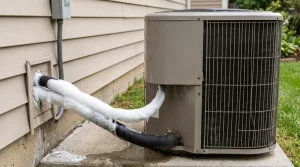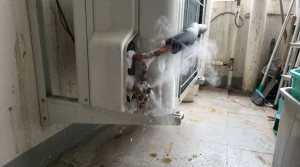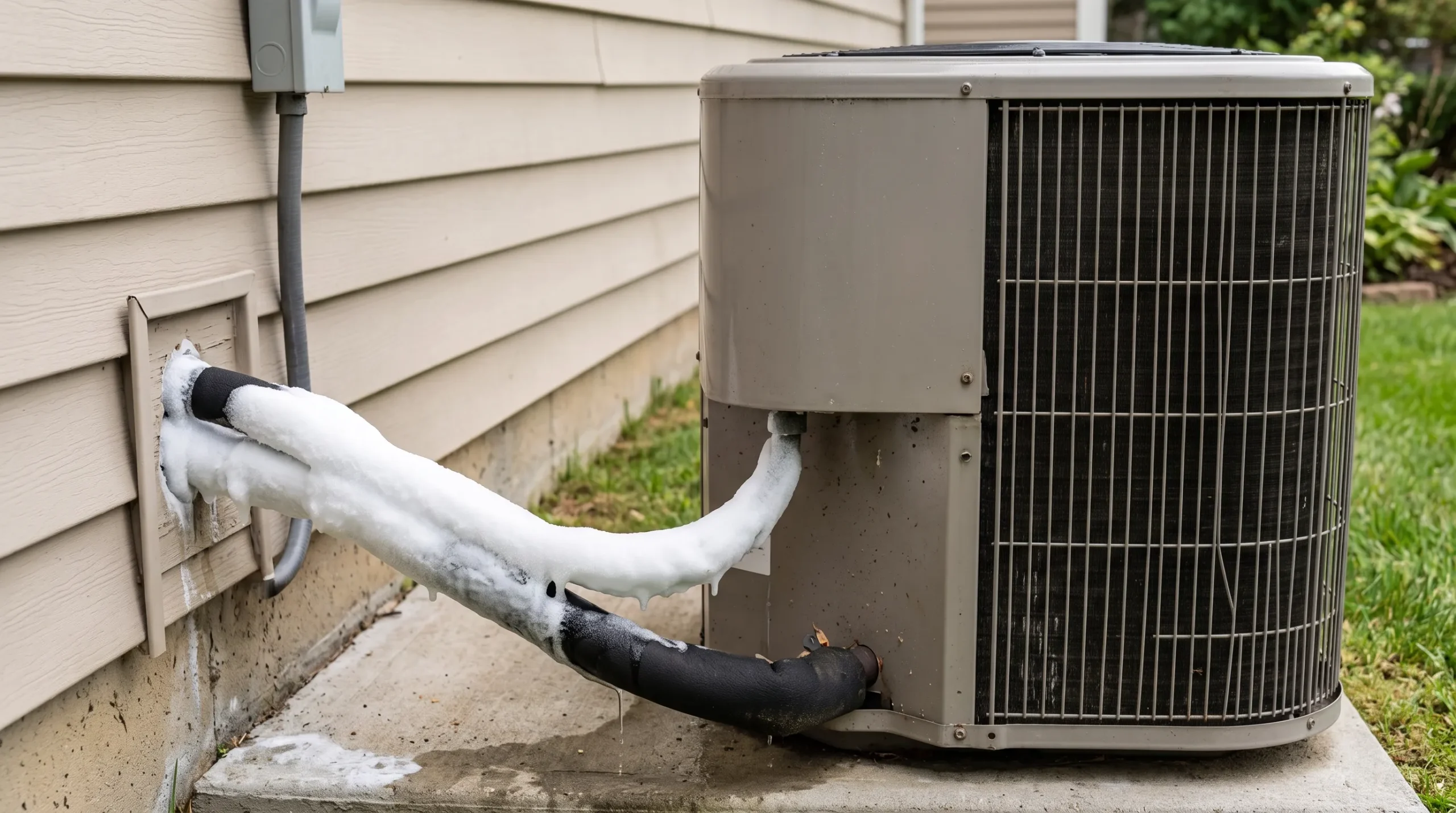
The frozen pipe at your outdoor unit is the suction line, the larger of the two copper lines, and it is covered in ice because the evaporator coil inside your house froze first. The cold traveled outward along the line. Something is either blocking airflow across that indoor coil or the refrigerant charge has dropped, and both push the coil below 32 degrees so humidity freezes onto it instead of draining away. Turn the cooling off right now and set the fan to “on.” The ice is not the problem, it is the symptom, and every hour the system runs frozen is an hour of liquid refrigerant working its way back toward the compressor.
Key takeaways
- Ice outside almost always starts inside. The indoor coil freezes first, then the cold migrates out along the suction line.
- Which line is frozen matters. Ice on the large insulated line is common. Ice on the small bare line is unusual and points at a restriction.
- The two root causes are airflow and refrigerant. Nearly every case on this list is one or the other.
- Shut the cooling off and run the fan the moment you see ice. Never chip, scrape, or heat the ice off.
- A full thaw takes a few hours. Restarting before the ice is completely gone just refreezes it.
- If it ices up again after a proper thaw, stop. Repeat freezing has a root cause that will not resolve on its own.
- Never touch the refrigerant lines, the service valves, or the capacitor. Those are call-a-pro items every time.
First, know which pipe is frozen
Two copper lines run between your outdoor unit and your house. The larger one is usually wrapped in black foam insulation and carries cold refrigerant vapor back from the indoor coil. That is the suction line, and it is the one that ices over in the overwhelming majority of calls we get.
The smaller line is bare copper and carries warm high-pressure liquid out to the coil. It should feel warm to the touch while the system runs. Ice on that line is uncommon and usually means a restriction somewhere in the system rather than a simple airflow problem.
Note which one is frozen before you call anyone. It genuinely narrows the diagnosis.
1. A dirty air filter is starving the indoor coil
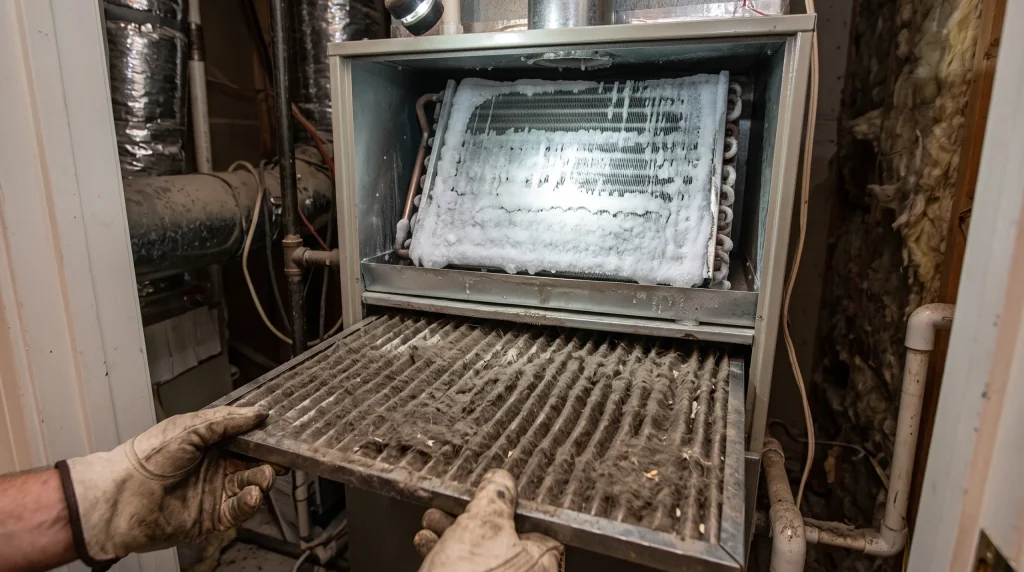
Symptom: Ice sleeving the large copper line outside, weak airflow at the vents, and air that is not cold even though the system is clearly running.
Most likely cause: A clogged filter. This is the number one reason we get frozen line calls in a Bedford summer. The evaporator coil needs a constant stream of warm indoor air to absorb heat from. Block that air and the coil has nothing to warm it, so its temperature falls below freezing and moisture ices onto it. That cold then travels out along the suction line to the pipe you are looking at.
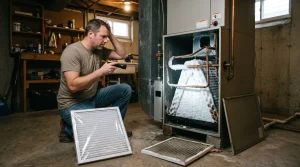
Fix steps: Switch the cooling off at the thermostat and set the fan to “on.” Pull the filter and hold it to a light. If light will not pass through, replace it. Leave the fan running until every trace of ice is gone, then restart in cool mode.
Call a pro if: It ices up again within a day or two of a fresh filter.
How to fix a frozen AC line caused by a dirty filter
This is the cheapest fix on the list and it resolves a large share of frozen line calls. In July and August, when the system may run eighteen hours a day, check the filter monthly rather than quarterly. Our guide to cleaning an HVAC filter covers the process. If you have already swapped the filter and it froze anyway, the next steps are in Why Does My AC Keep Freezing Up After I Changed the Filter? 5 Causes.
2. Low refrigerant from a leak
Symptom: Ice concentrated at the outdoor unit, often right at the service valves, with the system running all day and never quite cooling. Sometimes an oily film on the line set.
Most likely cause: A low charge. Pressure and temperature move together in a refrigerant loop. When the charge drops, so does the pressure in the coil, and the refrigerant boils at a lower temperature. Drive that below freezing and ice forms. This is the cause that most often produces ice out at the unit rather than only on the indoor coil.
Fix steps: None at home. Shut the system off to protect the compressor and schedule a technician. Refrigerant handling requires federal certification, and the leak has to be found and repaired before any recharge is worth paying for.
Call a pro if: Always, for anything refrigerant related.
Why low refrigerant freezes the copper line at the outdoor unit
Ice that starts outside and works its way in, rather than the reverse, is one of the better clues that you are dealing with charge instead of airflow. The full symptom list is in How Do I Know if My AC Is Low on Refrigerant? 7 Signs of a Freon Leak. Refrigerant is regulated by the Environmental Protection Agency, and only a certified technician may legally open the system.
3. A dirty evaporator coil
Symptom: Repeated icing even with a clean filter, cooling that has weakened gradually over several seasons, and sometimes a musty smell when the system starts.
Most likely cause: Buildup on the indoor coil. Even a good filter lets a fine film through over the years. That film insulates the coil so it cannot absorb heat from the passing air, which produces exactly the same result as a blocked filter: a coil running too cold, and ice that spreads out to the line.
Fix steps: Thaw the coil completely first, cooling off and fan on. Light surface dust on an accessible coil can be vacuumed gently. A real cleaning means opening the air handler and working on a coil inside sealed ductwork, so that part is a professional job.
Call a pro if: Cooling is down and the filter is clean. That pairing points at the coil almost every time.
Why a dirty coil freezes the AC line outside your house
Coil fouling is slow, so people rarely connect a gradual decline to the sudden block of ice that finally shows up in August. Catch it early with our guide on dirty evaporator coil symptoms, and read the Department of Energy guidance on coil and filter maintenance for what routine care should include. An annual AC tune-up is what keeps this one from ever reaching the ice stage.
4. A weak or failing blower motor
Symptom: Very weak airflow from every vent even with a clean filter and open registers, sometimes with a hum, a rattle, or a delay when the system starts.
Most likely cause: A blower motor or its capacitor going bad. The blower is what pushes warm indoor air across the coil. When it slows down or struggles to start, the coil gets less air than it needs and freezes, exactly as if a duct were blocked. From the thermostat the two look identical.
Fix steps: Confirm the filter is clean and every supply vent is open first, since both mimic this. If airflow is still weak, the motor or capacitor needs a professional diagnosis. Capacitors store a dangerous charge even with the power off, so this is not something to test yourself.
Call a pro if: Airflow stays weak once the filter and vents are ruled out.
How a bad blower motor causes ice on the AC line
A dying blower is one of the most commonly missed causes because nothing looks wrong at the outdoor unit. Our guides on an AC fan not working and what a capacitor does cover the parts and the failure sounds, and the repair itself falls under standard HVAC repair work.
5. Missing or damaged insulation on the line set
Symptom: The large copper line is bare, cracked, or crumbling where the foam should be, and it sweats heavily or grows frost along the exposed sections while the rest of the line stays clear.
Most likely cause: Degraded line insulation. That black foam is not decoration. It keeps the cold suction line from condensing humidity out of the outdoor air. Texas sun destroys unprotected foam over several summers, and rodents and string trimmers finish the job. Once the line is bare, it sweats constantly, and if the coil is running even slightly cold, that moisture frosts.
Fix steps: Replacing exposed foam insulation is one of the few genuinely DIY items here, since it is a foam sleeve, not a refrigerant component. Use closed-cell insulation rated for outdoor UV exposure, or the replacement will fail again in two summers. Do not disturb the service valves or fittings while you work.
Call a pro if: The insulation was never installed correctly in the first place, or the sweating continues after the foam is replaced.
Why bare copper lines frost and sweat in Texas humidity
This is the one cause on the list that is cosmetic in origin and expensive in effect, because constant condensation drips onto whatever sits below it and drives up runtime. Missing insulation usually traces back to the original HVAC installation or to a repair where the foam was never properly resealed. Keeping the outdoor unit clear and inspected is covered in our guide to outdoor AC unit maintenance, and if runtime and bills have climbed alongside it, an energy assessment will show what it is costing you.
6. A stuck expansion valve or metering device
Symptom: Persistent icing that returns no matter how clean the filter and coil are, sometimes with ice on the small bare line rather than the large one, uneven cooling, or a system that starts and stops repeatedly.
Most likely cause: A failing metering device. The expansion valve controls how much refrigerant enters the evaporator coil. When it sticks open it floods the coil, and when it sticks closed it starves it. Either condition can drop the coil below freezing, and a restriction at the valve is the classic reason the small liquid line ices when it should be warm.
Fix steps: None at home. This is a sealed-system component that requires gauges, refrigerant recovery, and certification to diagnose and replace.
Call a pro if: Always. Once airflow and charge have been ruled out, this is the most likely remaining cause.
How a failing expansion valve freezes the AC refrigerant line
This is the hardest cause on the list to pin down without instruments, which is exactly why the other five get ruled out first. Our master guide, Why Does My AC Freeze Up When It’s 100 Degrees Outside? 9 Causes, walks through the full diagnostic order. A system that also short cycles usually shares a single root cause with the icing. On equipment past twelve or fifteen years, weigh a sealed-system repair against HVAC replacement before spending the money, and our guide on repairing versus replacing an AC unit covers how that math usually lands.
DIY-safe vs. call-a-pro: a frozen AC line outside
|
Cause |
Safe to DIY |
Call a pro |
|
Dirty air filter |
Yes. Thaw and replace |
If it refreezes within days |
|
Low refrigerant from a leak |
No, never |
Always. Federally regulated |
|
Dirty evaporator coil |
Light surface dust only |
Full coil cleaning |
|
Weak blower motor |
Rule out filter and vents only |
Motor or capacitor repair |
|
Damaged line insulation |
Yes. Replace the foam sleeve |
If sweating continues after |
|
Stuck expansion valve |
No |
Always |
|
Thawing the ice |
Yes. Fan on, cooling off |
If it will not fully thaw |
|
Chipping or heating the ice |
Never |
The coil punctures easily |
The bottom line for Bedford homeowners
A frozen copper line is not a plumbing problem and it is not something you fix at the pipe. It is your indoor coil telling you it cannot breathe or it is losing refrigerant, and the ice outside is just where the symptom became visible. The sequence never changes: shut the cooling off, run the fan until every trace of ice is gone, then check the filter and the vents before you do anything else.
What matters most is what you do if it comes back. A system that refreezes after a proper thaw has a real fault, and running it through repeated freeze cycles is how a filter change turns into a compressor replacement. There is no version of this where waiting makes it cheaper.
If the line at your outdoor unit keeps icing over after you have handled the basics, AC Repair DFW can find the cause instead of thawing the symptom. Book same-day service or request a free quote, and a licensed technician will check airflow, verify the charge, and tell you exactly what the repair is worth on your system.