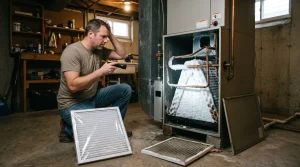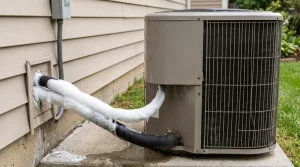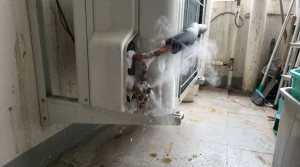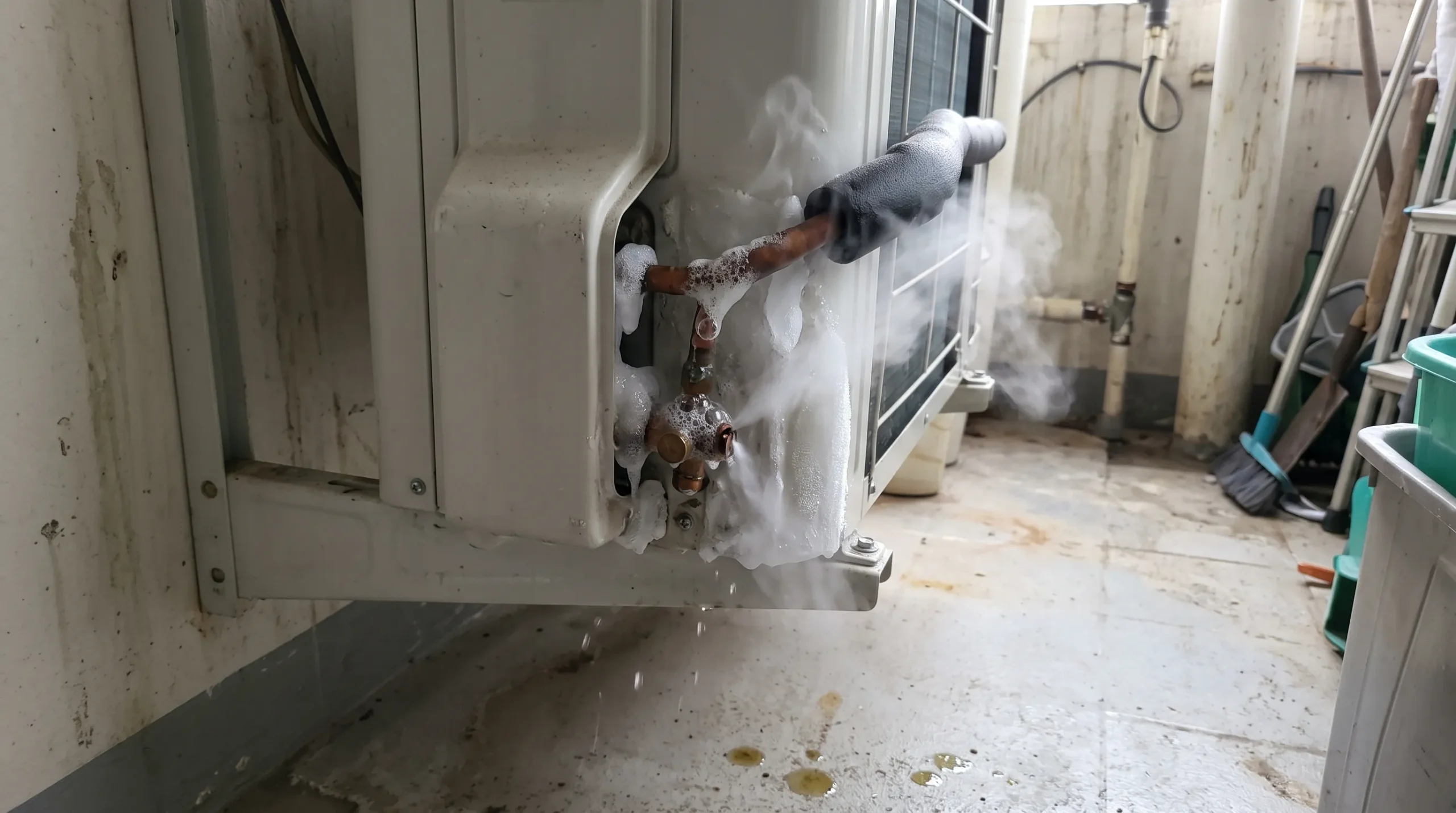
Your AC is low on refrigerant if it runs constantly but only blows mildly cool air, ices over on the copper line or the indoor coil, takes longer and longer to reach the thermostat setting, and leaves the house feeling humid. You may also hear a faint hiss near the indoor unit or find an oily film on the line set. Here is the part that matters most: refrigerant is not a fuel and it does not get used up. It circulates in a sealed loop for the life of the system. So if the charge is low, there is a leak, and topping it off without repairing that leak just buys you a few weeks. Refrigerant work is federally regulated and requires certification, so this is a call-a-pro repair every time.
Key takeaways
- Low refrigerant is always a leak. A system that is properly charged and sealed never needs a recharge.
- The clearest single tell is weak cooling combined with ice, since a low charge lowers coil pressure and drops the coil below freezing.
- Rising electric bills with no change in how you use the AC are an early warning, often months before the cooling visibly fails.
- A humid, clammy house at a normal temperature setting points at charge or airflow, not at the thermostat.
- Running a low system risks the compressor, which is the single most expensive part to replace.
- You cannot check the charge yourself. It takes gauges, and attaching them legally requires federal certification.
- Recharging without a leak search is money spent twice. Insist on a leak search before anyone adds refrigerant.
1. The air is cool but never cold, and the system never shuts off
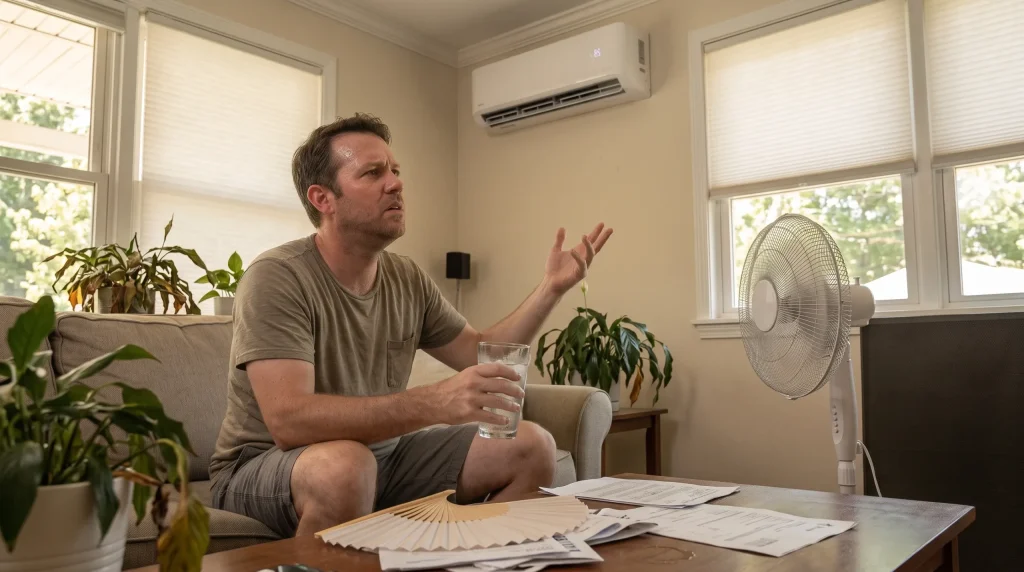
Symptom: Air still comes out of the vents, and it is not warm, but it never feels genuinely cold. The system runs hour after hour without cycling off.
What it means: The refrigerant is what actually carries heat out of your house. With less of it in the loop, each cycle removes less heat, so the system compensates the only way it can, by running longer. On a mild day you may not notice. On a 100-degree afternoon it simply never catches up.
What to check first: Rule out the cheap causes before you assume a leak. Replace the filter, confirm every supply vent is open, and rinse the outdoor coil. If cooling is still weak after all three, charge becomes the leading suspect.
Call a pro if: Cooling stays weak with a clean filter, open vents, and a clean outdoor unit.
Why low refrigerant makes an AC blow cool but not cold air
This is the most common way a leak announces itself, and it is easy to mistake for a system that is simply old or undersized. Our guide on an air conditioner blowing warm air covers how to tell a charge problem apart from an airflow problem, and a dirty condenser can produce nearly identical symptoms, which is why an outdoor unit that is not cooling is worth ruling out first.
2. Ice on the copper line or the indoor coil
Symptom: Frost or a solid sleeve of ice on the larger copper line at the outdoor unit, or ice visible on the indoor coil, usually with almost no airflow at the vents once it builds up.
What it means: Pressure and temperature move together in a refrigerant loop. When the charge drops, the pressure in the evaporator coil drops, and the refrigerant boils at a lower temperature. Push that below 32 degrees and the humidity condensing on the coil freezes instead of draining away. The ice then blocks airflow, which makes the freeze worse.
What to check first: Turn the cooling off immediately and set the fan to “on” to thaw it. Do not chip or scrape the ice. Coil walls are thin and easy to puncture, which turns a leak you have into a bigger one.
Call a pro if: It refreezes after a full thaw, or the ice is on the copper line outside rather than the indoor coil. Line icing points at charge far more often than at airflow.
How to tell if a frozen AC coil is caused by low refrigerant
Ice has two families of causes, airflow and refrigerant, and telling them apart saves you a wasted service call. The full breakdown is in our master guide, Why Does My AC Freeze Up When It’s 100 Degrees Outside? 9 Causes, which walks through all nine and shows where a leak sits among them.
3. Your electric bill climbed but nothing else changed
Symptom: Summer bills noticeably higher than the same month last year, with no new appliances, no new occupants, and no change to your thermostat habits.
What it means: A system short on refrigerant does not stop working, it works longer. Runtime is what you pay for. This is usually the earliest sign of a slow leak, and it often shows up a full season before the cooling gets bad enough to complain about.
What to check first: Pull up last year’s bill for the same month and compare. Then check the filter and the outdoor coil, since both also raise runtime.
Call a pro if: Runtime and bills are up while your habits have not changed. Catching a slow leak at this stage is much cheaper than catching it after the compressor fails.
Why a Freon leak raises your electric bill before it stops cooling
Efficiency degrades long before comfort does, which is exactly why this sign gets missed. ENERGY STAR lists refrigerant charge among the items a contractor should verify at every annual visit, and a proper energy assessment will separate a charge problem from duct loss or thin attic insulation if you are not sure which is driving the bill.
4. Run times keep getting longer and the setpoint slips out of reach
Symptom: The house held 72 last summer. This summer it holds 75, then 78, and on the hottest afternoons it climbs regardless of what the thermostat says.
What it means: Capacity is falling as the charge drops. A healthy system is generally built to pull indoor temperature roughly 18 to 22 degrees below the outdoor temperature. As refrigerant leaks out, that gap narrows, so the failure shows up first on the hottest days and only later on mild ones.
What to check first: Note the outdoor temperature when it happens. If the house holds fine at 90 outside but loses ground at 103, that is a capacity problem, and charge is one of the two usual causes.
Call a pro if: The gap the system can hold keeps shrinking week over week. That is a leak getting worse, not a system having a bad day.
Why an AC low on Freon runs constantly in hot weather
North Texas averages roughly twenty 100-degree days a year according to the National Weather Service, and those are the days a marginal charge stops being marginal. Airflow restrictions cause the same symptom, so if you have already replaced the filter and it did not help, work through Why Does My AC Keep Freezing Up After I Changed the Filter? 5 Causes before assuming refrigerant. A system that runs nonstop and then shuts down early is a different problem again, covered in our guide on AC short cycling.
5. A hiss, a bubble, or a faint gurgle near the indoor unit
Symptom: A soft hissing from the air handler or along the line set, or an intermittent bubbling and gurgling sound while the system runs.
What it means: A hiss is refrigerant escaping through a small breach under pressure. Bubbling or gurgling usually means the loop has drawn in air or the charge has dropped far enough that liquid and vapor are mixing where they should not. A loud hiss or a shriek is different and more urgent, since that can indicate a high-pressure problem.
What to check first: Nothing invasive. Note where the sound is loudest and when it happens, which helps a technician find the breach faster. Do not open panels or probe the line set.
Call a pro if: You hear any of these. Shut the system off if the sound is loud, and get it looked at.
What a refrigerant leak sounds like in an AC system
Most refrigerants are close to odorless, so sound is a better clue than smell. If you are smelling something instead of hearing it, that is a different diagnosis, and our guide on an AC that smells like gas covers what those odors usually mean. Leave the diagnosis to a technician either way, because pinpointing a leak takes electronic detection or dye, not guesswork, and the repair itself falls under HVAC repair work that requires certification.
6. Oily film or grime on the line set and fittings
Symptom: A greasy, dirt-collecting residue on the copper lines, at a brazed joint, at the service valves, or on the base of the outdoor unit.
What it means: Refrigerant circulates with compressor oil. When refrigerant escapes, traces of that oil come with it and stay behind at the breach, collecting dust into a visible smudge. It is one of the few leak signs you can actually see, and it often marks the exact spot.
What to check first: Look, do not touch. Note the location and photograph it. Fittings, service valves, and the point where the line set enters the wall are common spots.
Call a pro if: You find any oily residue on or around the refrigerant lines. That is physical evidence of an active leak.
How to spot a refrigerant leak on the copper line outside
The line set outside is where leaks are easiest to see and where ice is easiest to notice. Our companion guide, Why Is the Pipe Outside My AC Frozen? 6 Causes of Ice on the Copper Line, covers what the ice pattern tells you and which causes are urgent.
7. The house feels humid and clammy at a normal temperature
Symptom: The thermostat reads a reasonable number, but the air feels heavy, windows fog, and nobody feels comfortable.
What it means: Removing humidity is half of what an air conditioner does. Moisture condenses on a cold coil and drains away. A weakly charged system runs a warmer coil and pulls out far less water, so the air stays damp even when the temperature looks fine. In a humid climate this is often what people notice before they notice the temperature.
What to check first: Confirm the system is actually producing condensate. A drain line that stays bone dry through a humid afternoon suggests the coil is not doing its job.
Call a pro if: Humidity stays high with the system running normally. Charge, airflow, and oversizing all cause this, and separating them takes measurement.
Why low refrigerant leaves your house humid in summer
Humidity control fails before temperature control does, which makes this a useful early sign. Our guide on the HVAC issues high humidity triggers covers the comfort side. Chronic humidity in a newer home sometimes traces back to equipment that was oversized or charged incorrectly at HVAC installation rather than to anything that later wore out.
DIY-safe vs. call-a-pro: a suspected refrigerant leak
|
Task |
Safe to DIY |
Call a pro |
|
Replace the filter to rule out airflow |
Yes |
If cooling stays weak |
|
Open all supply vents and clear returns |
Yes |
If it changes nothing |
|
Rinse the outdoor condenser coil |
Yes, power off |
If the coil is badly fouled |
|
Thaw a frozen coil with the fan on |
Yes |
If it refreezes after thawing |
|
Look for oily residue on the line set |
Yes, look only |
As soon as you find any |
|
Attach gauges to check the charge |
No, never |
Always. Federally regulated |
|
Locate the leak |
No |
Always. Requires detection tools |
|
Add refrigerant |
No, never |
Always, and only after the leak is repaired |
|
Repair or replace a leaking coil |
No |
Always |
The bottom line for Bedford homeowners
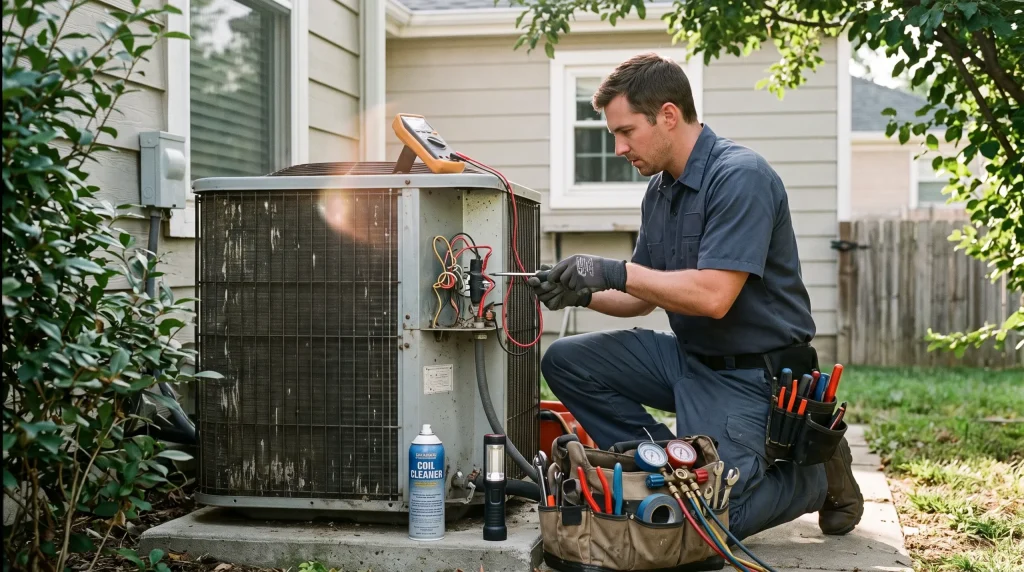
If you take one thing from this page, make it this: refrigerant is not a consumable. A system that needs a recharge has a leak, and any contractor who tops it off without looking for that leak is selling you the same repair again next summer. Insist on a leak search first, then a repair, then a recharge to the manufacturer’s specification.
The other thing worth knowing is when to stop repairing. A leak at an accessible fitting is usually a straightforward fix. A leak inside the evaporator coil on a system that is past twelve or fifteen years old, especially one still running an older refrigerant, is a different calculation, and our guides on repairing versus replacing an AC unit and replacing the evaporator coil versus the whole unit walk through the math. When the numbers favor starting over, HVAC replacement is often cheaper over three years than two more sealed-system repairs.
If your AC is cooling weakly, icing up, or running without a break, AC Repair DFW can find the leak instead of masking it. Book same-day service or request a free quote, and a licensed technician will test the charge, locate the breach, and tell you honestly what the repair is worth on your system.